Not a good week for Cruise. Cruise hasn’t been able to get out of the headlines since the CPUC decision that gave self-driving technology makers Waymo and Cruise permission to operate driverless robotic taxi fleets without restriction in San Francisco.
First, a dozen or so Cruise stopped at a festival and blocked the street for 15 minutes, at which point it turned out that an aggressive pedestrian had been at fault. Then a vehicle drove into a freshly concreted section of road, and in another incident a human-driven vehicle drove at high speed into an intersection at a red light and collided with a Cruise.
And here is the video of it: from a surveillance camera:
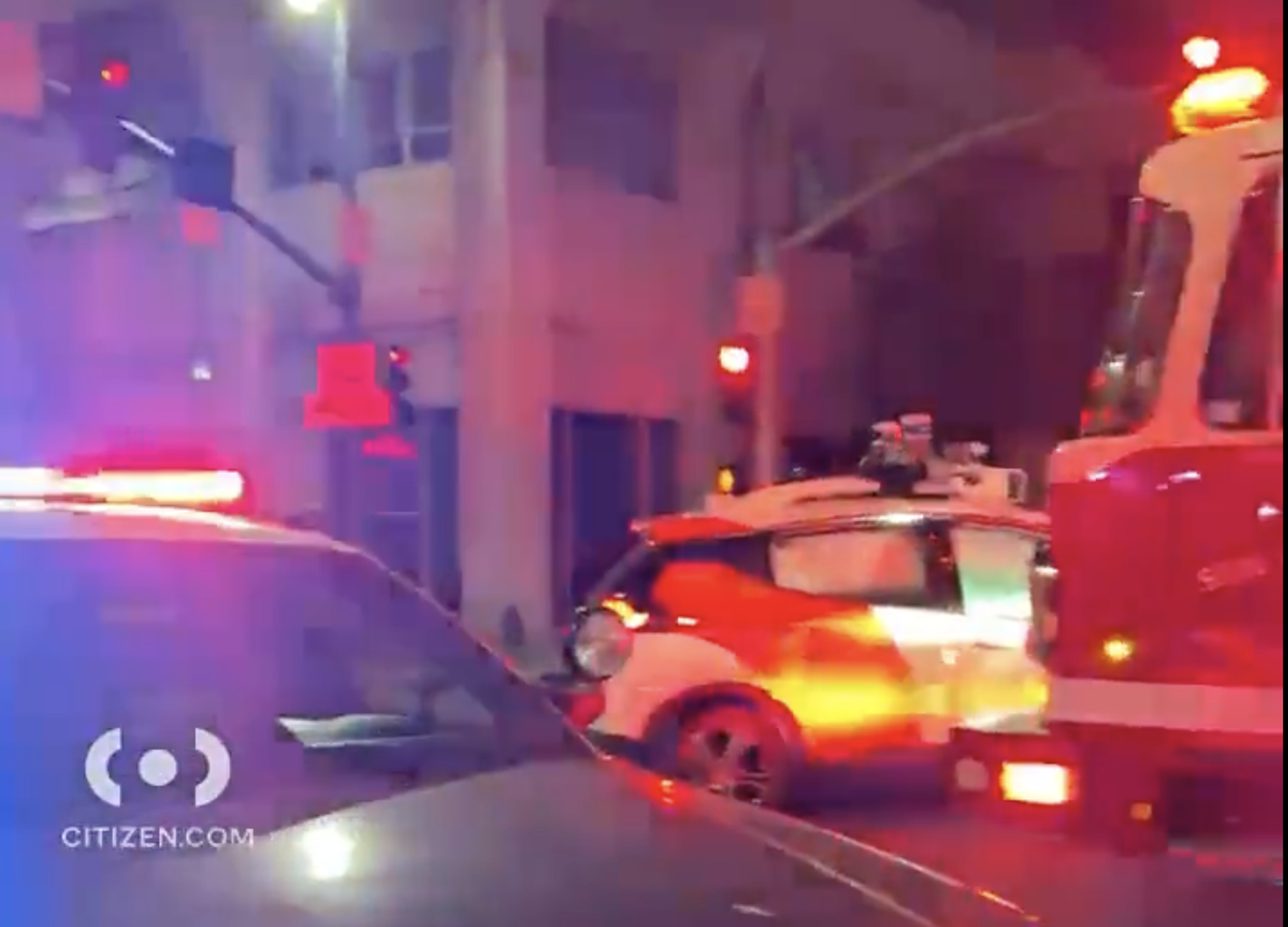
But the most serious case was a collision with an SF Fire Department ladder truck rushing to a call at 10 p.m. Thursday night at the intersection of Polk Street and Turk Street, in which the occupant of the Cruise Robotaxi was slightly injured and delivered to the hospital. The ladder engine T-boned the Cruise Robotaxi, the traffic light had been red for the emergency vehicle.
The intersection was difficult to see, Cruise announced in a press statement.
The AV positively identified the emergency vehicle almost immediately as it came into view, which is consistent with our underlying safety design and expectation. It is worth noting, however, that the confines of this specific intersection make visual identification more challenging – for humans and AVs alike – as it is significantly occluded by buildings, meaning that it is not possible to see objects around the corner until they are physically very close to the intersection.
The AV’s ability to successfully chart the emergency vehicle’s path was complicated by the fact that the emergency vehicle was in the oncoming lane of traffic, which it had moved into to bypass the red light.
Cruise AVs have the ability to detect emergency sirens, which increase their ability to operate safely around emergency vehicles and accompanying scenes. In this instance, the AV identified the siren as soon as it was distinguishable from the background noise.
The Cruise AV did identify the risk of a collision and initiated a braking maneuver, reducing its speed, but was ultimately unable to avoid the collision.
As a first reaction, the California Department of Motor Vehicles asked Cruise to reduce the number of driverless vehicles in San Francisco by 50 percent for the time being. Until the investigations are completed, only 50 driverless vehicles are allowed to operate during the day, and 150 at night.

 The Last Driver License Holder...
2 Comments