In my last article about Tesla’s FSD and what would happen if it became the standard for self-driving and other car companies are starting to use it, there was a push back by a number of users who claimed FSD to be an inferior standard that from a safety perspective – with cameras only and without e.g. LiDARs – would not be sufficient and certifiable.
One argument was the reference to Automotive Safety Integrity Level (ASIL), which classifies risks with ASIL D being the highest safety level of hazard (severe or fatal injury risk) with a failure rate of 10ˆ-8 per hour. Such a case would be the loss of all brakes. ASIL A on the other hand would be at 10ˆ-5 per hour.
With some street legal ADAS we already see that such a rate is by far not achieved, as anyone knows who has ever used an ADAS. And we’ve seen the shockingly bad performance of such a system that is certified and sold to consumers.
We can argue that self driving technologies by Waymo, Zoox or Cruise that use more sensor modalities including cameras, LiDARs, radars or ultra sound systems are safer than systems that rely one one sensor modality alone, such as Tesla’s FSD which is cameras only. While different sensors can overcome shortcomings of other sensors, such as LiDARs being able to see in the dark or seeing through fog, while cameras can not, every additional sensor modality adds complexity to the software code, decision process and sensor fusion. If data from different. sensors contradict each other, which sensor data will be then used to make the decision? With sensor fusion the software code becomes more complex,ultimately also leading to more software bugs.
| Bücher zum Silicon Valley, der Zukunft, künstlicher Intelligenz, dem aufregenden Thema Innovation, der Automobilindustrie oder wie man sich bloß nicht entschuldigt, mit anderen Worten alles gute Bücher von mir. Und die will ich Dir ans Herzen legen. |
 |
| Alle Bücher gibt es bei Amazon, beim Plassen- und Beck-Verlag oder beim Buchhändler des Vertrauens. Sogar als ebook gibt es sie beispielsweise hier. |
Besides, more sensors are more expensive, and while electronics prices have always fallen, in the short term this may still be out of reach for mass market adoption. But then we also know from past experiences that in the end algorithms always win. We have much better video compression algorithms than we had 20 years ago. We can squeeze more functionality out of older hardware thanks to software improvements than we had in the past. Just think of the Voyager probes, the Hubble telescope or even the five year old cameras on Teslas that we could fix or improve just by software updates.
Redundancy also is a often cited safety standard for safe driving. Without another sensor modality the failure of one sensor type is not redundant and therefore cannot be certified. Which is, considering other parts of the car, a kind of a lame argument. We don’t have redundant tires. One tire blowout can have catastrophic consequences. Here is such an example, where a truck’s front tire blows out (at 9:45 in the video):
A camera now failing would mean what exactly? Total and immediate chaos? Not so fast: one camera failing would mean the car has time enough to safely come to a stop. Like you would do with a blown out tire.
All these are important aspects, because we have historic example where the supposedly ‘better technology” did not become the standard. And there were different reasons for that: the “worse” technology was cheaper, had a higher adoption rate, or was better in one criteria that consumers found crucial: e.g. the recording times of video tapes. If I couldn’t record a full movie length on the better technologies video tape, then forget it.
Technology Standard Examples
Here are some examples, where a technology became a standard that was not the technologically “best”, but in a mix of criteria “good enough” for what users wanted to accomplish.
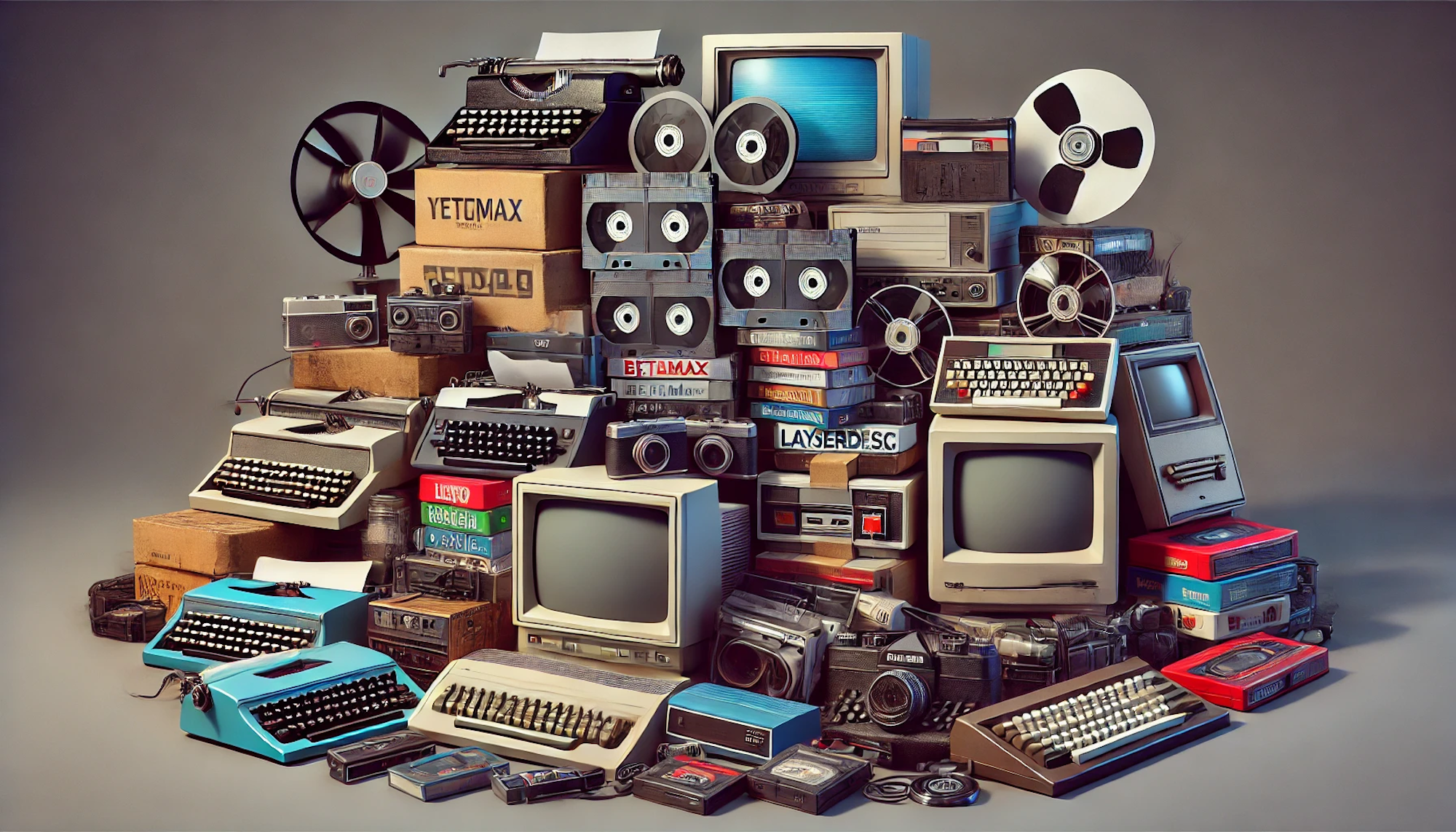
VHS vs Betamax vs Video 2000
Betamax had better video and audio quality, but VHS had longer recording times and a more open licensing model. Video 2000 had also better video quality than VHS and long recording times including a two sides of the tape, like an audio tape, but it was only manufactured by one company which decided to shut it down after not gaining enough market share. All those factors allowed more manufacturers to produce VHS players, leading to lower prices and wider adoption.
Laserdisc vs DVD
Laserdisc offered higher-quality analog video and audio compared to VHS, but was more expensive and the discs were bulkier. The smaller, cheaper, and more convenient DVD format ultimately won out.
HD DVD vs Blu-ray
HD DVD had some technical advantages like a simpler manufacturing process, but Blu-ray had the backing of more major studios and consumer electronics companies, allowing it to become the dominant high-definition optical disc format. B
Atari ST vs IBM PC vs Apple Macintosh
The Atari ST had impressive sound and graphics capabilities, but was ultimately overshadowed by the more widely adopted IBM PC compatible and Apple Macintosh platforms, which had stronger software ecosystems and business support.
Dvorak keyboard vs QWERTY
The Dvorak keyboard is considered more efficient and ergonomic, but the entrenched QWERTY layout prevailed due to its early dominance and network effects
Tesla FSD as a Standard
We always take calculated risks and a hundred percent perfect solution is not possible. The question is how much do we allow and are willing to pay. We are still having no speed limits on parts of the German Autobahn, although we know that it’d be much safer to introduce a countrywide speed limit. But then German car drivers and automotive companies value to type of “fun” that no speed limits give. Denying that safety reality but demanding the highest safety approach from Tesla is nothing else than hypocrisy from the VDI, German OEMs and many self-driving skeptics.

KREATIVE INTELLIGENZ
Über ChatGPT hat man viel gelesen in der letzten Zeit: die künstliche Intelligenz, die ganze Bücher schreiben kann und der bereits jetzt unterstellt wird, Legionen von Autoren, Textern und Übersetzern arbeitslos zu machen. Und ChatGPT ist nicht allein, die KI-Familie wächst beständig. So malt DALL-E Bilder, Face Generator simuliert Gesichter und MusicLM komponiert Musik. Was erleben wir da? Das Ende der Zivilisation oder den Beginn von etwas völlig Neuem? Zukunftsforscher Dr. Mario Herger ordnet die neuesten Entwicklungen aus dem Silicon Valley ein und zeigt auf, welche teils bahnbrechenden Veränderungen unmittelbar vor der Tür stehen.
The conclusion is that Tesla’s FSD is a serious contender for becoming the first self-driving technology, if not the standard, that is used in mass produced vehicles. Not only does Tesla have by now almost seven million cars with the hardware capabilities out in the wild, but other car makers may benefit from it by licensing the technology. And this may be closer than a panel from the German Engineering Association VDI may be aware of, as they are so stuck in their standards and what engineers think is right that they overlook what consumers want.
Here the often quote “German overengineering” may make them blind for seeing this alternative. The assumption that self driving can only function with multi sensor modalities is so deeply entrenched that they are not even wasting a thought of what it would take to limit themselves to camera only systems and what it would take to use only one sensor modality. Especially in creative and engineering work, we have often seen that working within limitations lead to the best solutions.
And this is my take on why this VDI panel failed its purpose. By not considering Tesla FSD as a viable alternative solution, they are blind to this competitive threat.
This article was also published in German.

 The Last Driver License Holder...
2 Comments