
Elon Musk is a complex character with an equally complex past. I have just shed light on one of these sides and a possible scenario in the article Are we witnessing the decline of Tesla and Musk’s corporate empire? But I want to look at another side that is diametrically opposed to this scenario: could it be that Elon Musk becomes the first ten trillion dollar entrepreneur? Meaning that the companies he founded will be worth 10 trillion dollars?
If that seems a little highfalutin, then please be patient, because there are good arguments for it. Many shareholders are betting on it and from a techno-optimistic, hopeful view of the future, I would like to see it happen.
How It Started – Kind of
The Cybercab, a Robovan, several humanoid Optimus robots and a tower called Mechazilla, which uses its gripper arms to catch the 70-metre-high Super Heavy rocket stage returning from orbit at supersonic speed. These were the engineering feats that Elon Musk’s companies Tesla and SpaceX accomplished in just a few days in October 2024. Since then, Donald Trump’s victory in the US presidential election, which Musk actively supported, has pushed Tesla’s market value back above one trillion dollars.
Trump’s nominations for key government posts suggest that Musk’s companies could benefit from this. Fewer regulations and concerns would allow Musk’s technologies to be introduced more quickly. In addition, the Tesla boss has been given special powers by Trump, which he has already tried to use since Trump’s inauguration as the 47th president, although, as already mentioned, not without the unrestricted goodwill of the international public.
But let’s take a closer look at Musk’s corporate complex.
Tesla – Autonomous Cars
Let’s start with the We, Robot event from October 2024 and review it. Because this presentation had it all. I have been experiencing the vision of self-driving cars first-hand for years in Silicon Valley and with my Tesla Model 3. For a decade now, more than 2,600 autonomous test vehicles from at times over 70 different companies have been in the San Francisco Bay Area. Two years ago, they were made accessible to a wider public by allowing them to be ordered as a robotaxi in San Francisco via an app. Without a driver in the driver’s seat, the vehicles from Google sister company Waymo and GM subsidiary Cruise drove and still drive through the city. However, the development of Cruise has now been discontinued by GM.
While Waymo was already completing 50,000 driverless and paid rides per week in San Francisco and Phoenix in May 2024, by October it was already 150,000. I’ve actually used these driverless robotaxis more than 250 times and the message is clear: autonomous cars are here, they’re just not evenly distributed yet.


Elon Musk, on the other hand, has been announcing the autonomous Tesla for years. In fact, Tesla owners in North America have the Full Self Driving software (FSD for short) on their cars, which is not to be confused with the Autopilot available in Europe. The latter is a completely different software that is nothing more and nothing less than a driver assistance system. FSD, on the other hand, is aimed at autonomous driving, even if it is still legally considered a driver assistance system. It must be monitored by the driver, hence the addition “Supervised”.
I have been experiencing this version in different versions on my Tesla for two years, currently it is V12.6.3. There was a leap in quality when switching from version V11 to V12. Technically speaking, they differ in the way the artificial intelligence behind them has been trained Whereas in the past the system was taught the traffic rules by the engineers, the switch to V12 took advantage of the fact that Tesla can not only install updates on the cars via an online connection, but can also access driving data from more than seven million Teslas. This data was fed into Tesla’s supercomputer – the Tesla Dojo – eliminating bad and mediocre driver data and leaving only the driving records, videos and telemetric data of the good drivers in the system. The neural network was then instructed to make sense of this driving data itself. In other words, using pattern recognition to understand the rules and how human drivers steer a car in this reality.

The result was the aforementioned leap in quality. My Tesla drives much more like a human with the FSD, less hesitant, more comfortable and, above all, much safer. In the meantime, I have done a whole series of test drives that took me to other parts of the city in San Francisco’s heavy traffic without having to intervene and correct once during the half-hour drive. And the feat is accomplished with Tesla’s standard equipment: eight exterior cameras and two GPU chips. This system costs a low four-figure sum, and not five figures, as is the case with Waymo and Cruise, which carry several radars and expensive LIDARs in addition to the cameras.
This version V12 is the first one where I can now very well imagine a Tesla robotaxi being within reach. And it’s not just limited to a restricted operating area like Waymo or Cruise, for example, which can only drive in a precisely pre-mapped area. The software architecture of the Tesla FSD creates navigation maps while driving and aims to be able to navigate everywhere Teslas already drive today. For example, the whole of North America, China or Europe. At present, almost all of the eight million Teslas delivered are already FSD-capable. With a software update, Tesla will be able to enable autonomous driving for its fleet in customer hands.
A dedicated robotaxi without a steering wheel is therefore only the logical next step. And this is where Tesla has an advantage over other manufacturers of self-driving systems. Tesla is a car manufacturer that can build the corresponding quantities. The Cybercab presented last week, a steering wheel-free robotaxi for two people, will revolutionize mobility for urban and interurban journeys. And thanks to the technology, it will also be cheaper and achieve such low prices per kilometer in a sharing system in a robotaxi fleet that it will be a strong competitor to public transport. Or it will be embedded in public transport as another form of mobility. Musk showed that he intends to do this with the Robovan, a minibus for up to 20 people that emulates a positive vision of the future in a stylistic reference to the Mercury Streamliner locomotive from the 1930s.


Combining electromobility with autonomous driving opens up unimagined possibilities for new forms of mobility. The skateboard platform (battery and electric motor) with superstructures in any shape allows not only the transportation of people but also goods.
According to IBIS World, the market value of the 92.7 million cars sold worldwide in 2023 amounted to $4.3 trillion. According to MarketsandMarkets, the market for autonomous vehicles, which includes driver assistance systems (levels 1, 2 and 3) and autonomous driving (levels 4 and 50), amounted to 20.3 million units in 2021 and is expected to reach 62.1 million units in 2023. The total value is expected to reach $13.6 trillion in 2030 according to Fortune Business Insight. Those who revolutionize these markets can bring the company value into the trillion-euro region.


Tesla itself does not only have to occupy the market with its own cars. The company can expand its reach by licensing its FSD to other car manufacturers. Some time ago there were rumors about licensing negotiations with Ford, and now there are rumors about the Chinese manufacturers SAIC and Geely. The Chinese government is said to have a hand in this, requiring Tesla to partner with domestic manufacturers in the development and use of FSDs in return for the approval of FSDs in China.
Robots – The New Minions
Musk’s Tesla has another ace up its sleeve, the significance of which is not yet fully understood by many. The Tesla Optimus robot. What at first glance looks like a funny but unhelpful and expensive toy is a previously unknown form of mobility. This humanoid bot was initially actually equipped with the Tesla FSD and can move not only on the streets, but even inside buildings. And thanks to its hands, it can also be used in manufacturing and lend a hand around the home. This also shows the vision behind the FSD and how flexibly it has been designed.
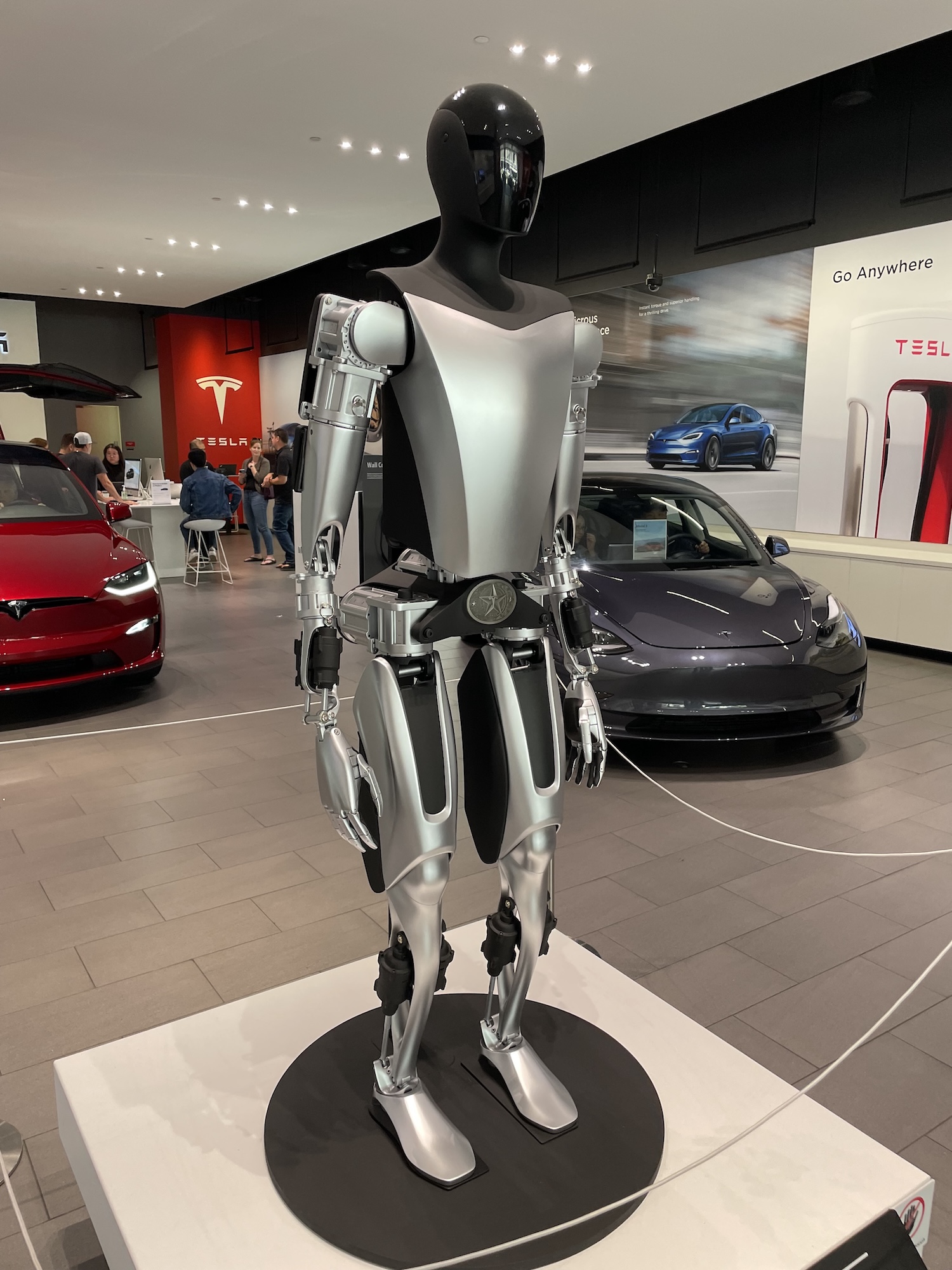
This will not generate the enthusiasm among employees and customers that we experienced at the We, Robot event and the fifth test flight of the Starship with the capture of the Super Heavy rocket stage. And that is not to inspire the next generations of engineers to achieve great things. This brings us to the question of when we have achieved an engineering feat that has triggered such storms of enthusiasm? I can only think of the Zeppelin, and that time was more than 100 years ago.
SpaceX and Starlink – Factories in Space
With almost two launches per week and 96 in 2023, SpaceX accounted for more than half of all 180 private rocket launches and three times as many as space agencies themselves, which amounted to 30 launches. Not only that. Thanks to synergies with Musk’s experience in automotive metalworking, continuous improvements to rocket engines and the recycling of rocket stages, SpaceX is currently unbeatable in terms of rocket reliability and cost. While some aerospace companies charge more than $20,000 per kilogram, SpaceX’s costs are now less than one hundredth of the competition at $150. And with the Super Heavy Starship, these costs are expected to fall to between $10 and $20 per kilogram.
Apart from Musk’s vision of flying to Mars with this rocket system, something else is much more interesting. He is creating a new market for factories in space. Thanks to the low transportation costs, factories in low-Earth orbit are beginning to pay off, where new or better materials and active ingredients can be produced in the weightlessness of Earth’s orbit at affordable costs. According to Global Market Insight, this market was worth $4.4 billion in 2023 and is expected to reach $21.8 billion in 2032.
The global satellite market is more interesting. According to Allied Market Research, this is expected to grow to $615.7 billion by 2032, and Musk has his fingers in the pie with StarLink. SpaceX has already launched over 6,000 satellites to form the StarLink “Internet from space” system. And by the way, he is also making himself irreplaceable for the American military and government. Revenues of 12.3 billion dollars are already expected for Starlink in 2025, almost double the estimated revenues of 7.6 billion dollars in 2024.
Neuralink and X.ai
It is less clear, as with the companies mentioned, but it is clear with these two companies that, thanks to Musk’s resources and experience from his other companies, they can become leaders in their sectors. Most people are already aware of this with AI, but even less so with a new product category such as the one Neuralink is pursuing with brain chip implants. But with the latter, the market could move from a medically necessary use for the disabled to one of expanding capabilities, such as direct access to knowledge or new senses, as with beauty products, opening the door to trillion-dollar markets.
Company Values – Today and Perhaps Soon
Having said all this, where might the individual company values in the Musk empire be in the period between 2030 and 2035? If we assume, for example, that the humanoid robot business is spun off from Tesla as a separate company, just as Starlink is spun off from SpaceX as a separate unit, and without taking into account any other company formations in the vicinity of these companies (e.g. Tesla Supercharger or X.AI Dojo vs. AI), then the company values could develop in the following direction:
| Company | 2025 | 2030 – 2035 |
| Tesla | $1.3 Trillion | $2.5 Trillion |
| Optimus Inc. | (in Tesla) | $2 Trillion |
| SpaceX | $0.35 Trillion | $3 Trillion |
| Starlink Inc. | (in SpaceX) | $2 Trillion |
| X.AI | ˜$0.01 Trillion | $1 Trillion |
| Neuralink | 0.008 Trillion | $0.5 Trillion |
| $1.66 Trillion | $11 Trillion |
Does this seem realistic? Tell me!
Elon Musk
Whatever one’s view of the controversial company boss Musk, his political views and his penchant for conspiracy confabulations, there is no denying that he not only has visions for the future, but also consistently implements them. Sometimes later, sometimes earlier, sometimes exactly in the time frame he has announced. But he has mostly delivered so far.
Elon Musk is a master in the art of the big bet. With his work in his companies, he has amassed something that cannot be bought so easily. He has innovation capital. When he sets up a rocket stage outside the venue during an appearance at an event or also places a Tesla Semi truck at the demonstration of robotaxis on the Warner Brothers studio lot, he is signaling the visions he has already turned into reality. With every other idea he puts forward, every vision of the future he outlines, investors would do well to listen carefully. He has proven countless times that he can turn ideas and visions into reality, that he can inspire capable engineers, that he can warm investors to invest. And he has made everyone involved rich several times, including himself.
He has created an empire of companies, most of which dominate the respective markets in the individual categories and set the standards. The synergy between these companies allows the rapid transfer of resources and knowledge from one Musk company to another. Musk’s innovation capital allows his companies to raise a lot of capital very quickly and accelerate product development and go-to-market.
Musk has shown several times that he can successfully create and occupy markets, and that he is well on his way to becoming the first ten-trillion-dollar entrepreneur in history. With the art of the big bet, Musk has a pretty good hand, but his future also depends on how his political activities can be reconciled with his entrepreneurial activities and how many new fans and enemies he creates. Because it can also go the other way round, as mentioned here.
| Books on Silicon Valley, the future, artificial intelligence, innovation, t he automotive industry or how not to apologize, in other words all good books from me. And I want to recommend them to you. |
 |
| All books are available on Amazon, from the Plassen and Beck publishing houses, or from your favorite bookseller. They are even available as ebook here, for example. |
This article was also published in German.

 The Last Driver License Holder...
2 Comments