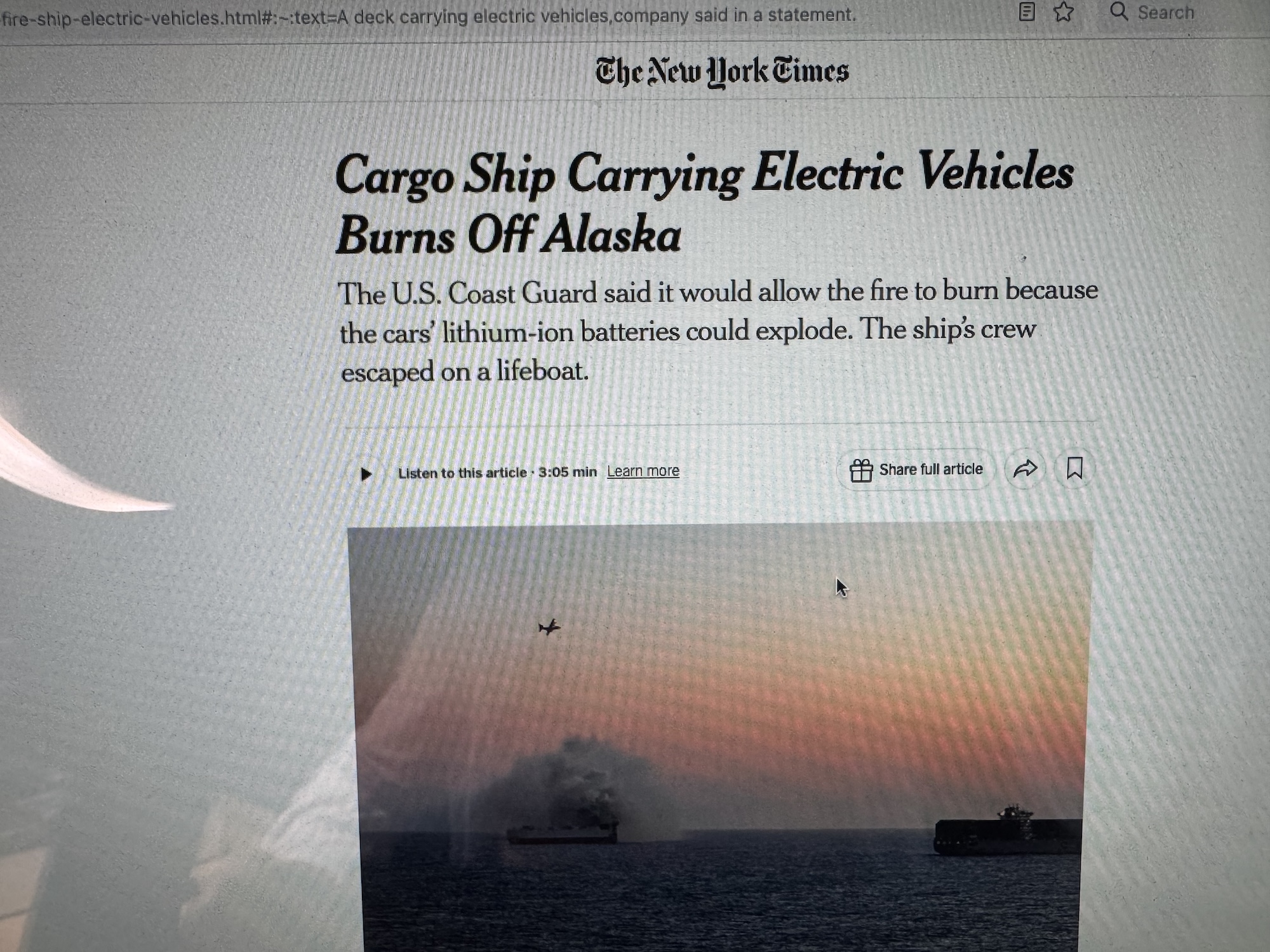
The car carrier Morning Midas caught fire near Alaska and the crew of 22 could not achieve much after attempts to extinguish the fire and had to abandon ship. The cargo on board comprised 3,000 cars, including 2,249 internal combustion vehicles, 681 hybrid vehicles and 70 (in words: seventy) electric cars.
The author of the NYT article, Francesca Regalado, draw razor-sharp conclusions about the cause of the fire:
Electric vehicles contain lithium-ion batteries that can overheat and cause fires that spread rapidly and produce toxic gases, making them difficult and dangerous to extinguish.
Let’s take a closer look at the figures on the frequency of car fires broken down by drive type:
- Electric cars: 25.1 fires per 100,000 vehicles sold
- Combustion engines (petrol/diesel): 1,529.9 fires per 100,000 vehicles sold
- Hybrids: 3,474.5 fires per 100,000 vehicles sold
This means that electric cars burn around 60.95 times less often than vehicles with combustion engines and 138.98 times less often than hybrids. Insurance statistics and studies by the Fraunhofer Institute and the US NTSB also confirm this: The fire risk for e-cars is not higher, but lower than for conventional drives. he media attention for e-car fires, however, often leads to a distorted perception.
What are the causes of car fires depending on the type of drive train?
- Combustion engines usually catch fire due to fuel leaks, electrical defects or mechanical damage.
- Electric cars have a different risk profile: the cause of the fire is usually the lithium-ion battery, especially after accidents or charging errors. If a battery catches fire, it is more difficult to extinguish and the fire can get very hot.
- Hybrids combine both systems and statistically have the highest fire frequency, presumably due to the more complex technology and the combination of high-voltage battery and combustion engine.
You also need to know that hybrids are not subsumed under electric cars; battery electric vehicles (BEVs), i.e. pure electric vehicles, are something completely different from hybrids, which not only have a small battery pack with an electric motor, but also a combustion engine with a gasoline tank on board.
In Germany, for example, more than 16,000 combustion vehicles burn every year.
So what do you take with you if you want to commit arson? Or light the coal at a barbecue? A battery or rather gasoline?
While the fire is still raging on the ship, the cause of the fire can only be speculated at present. The crew’s statement that the fire started on the deck with the “electric cars” cannot be verified at the moment. If “electric cars” also refers to hybrids, then a more precise distinction must be made here, as the probability that the fire started in a purely battery-electric car is 138.98 times lower than that of hybrids and 60.95 times lower than that of “combustion engines”.
The Fremantle fire was similar. We remember: in the summer of 2023, this car carrier burned for a week and everyone said that electric cars were to blame for the fire. When the ship was inspected, the electric cars were all intact, it was the combustion engines that had burned.
This article was also published in German.

 The Last Driver License Holder...
1 Comment