
The summer slump in reporting no longer seems to exist,, as the news about VW subsidiary MOIA, which is developing a robotaxi service, just keeps coming. A few weeks ago, the company presented its robotaxi with Volkswagen at the UITP Summit in Hamburg, which is to be used from next year, but just four weeks later the news comes that MOIA has discontinued its driving service in Hanover. After winter tests in Oslo, a test program in London and preparations for a launch with Uber in Los Angeles, the only remaining operation is currently in Hamburg.
MOIA CEO Sascha Meyer justifies the discontinuation in Hanover with a strategic realignment from a ride service provider to a self-driving technology developer, the unclear market positioning where the company has entered into competition with other ride service providers and – curiously enough – the higher VAT in Hanover (19%) compared to Hamburg (7%). Is this really an argument when developing new technology?
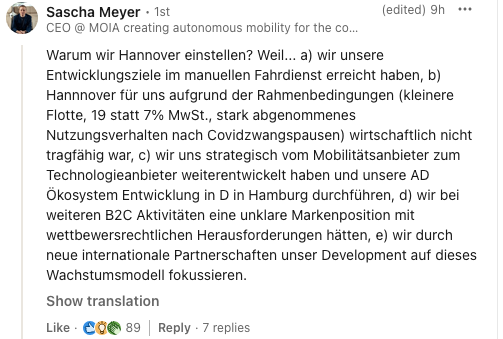
Why are we hiring Hanover? Because… a) we have achieved our development goals in the manual driving service, b) Hanover was not economically viable for us due to the general conditions (smaller fleet, 19% instead of 7% VAT, sharp decline in usage behavior after mandatory Covid breaks), c) we have strategically evolved from a mobility provider to a technology provider and are carrying out our AD ecosystem development in Germany in Hamburg, d) we would have an unclear brand position with competition law challenges in further B2C activities, e) we are focusing our development on this growth model through new international partnerships.
One would expect that before the start of a robotaxi operation, corresponding tests with the recently presented robotaxi ID.Buzz AD would be started, even in regions where a taxi service is perhaps already in operation, and thus the public already familiar with it could be accessed as test passengers. Restricting activities seems unlikely to build confidence.
Given my 10 Rules of Thumb for understanding how good a self-driving technology company is, I take a critical view of this development. Add to that news from partner Mobileye, which provides the self-driving technology for the MOIA Robotaxi. And yes, the technology comes from a third-party provider. Mobileye is a subsidiary of chip giant Intel, which has been struggling with difficulties for years and is increasingly losing ground to Nvidia, which is worth 40x more, and AMD (worth 2.5x as much). Mobileye itself has quarterly revenues of around $500 million per quarter, with profits of around $100 million. Still, these amounts don’t seem enough when you consider the vast sums that other companies have put into developing self-driving technology so far. Waymo spent a reported $20 billion, and GM spent $10 billion with Cruise before the project was canceled.
MOIA shares
As reported by manager magazin, VW CEO Oliver Blume wants to sell shares in the subsidiary MOIA, which is managed by the VW unit ADMT (Autonomous Driving, Mobility & Transport). Other parts of the company are also to be sold off, with which VW hopes to raise €6 to €8 billion.
What Senger did not reveal to the top executives was that he was not only offering his robotaxis – but also company shares. Volkswagen is planning a major capital increase and is putting a minority stake up for sale. Several people involved confirmed this to manager magazin. Group CEO Oliver Blume (57) has stated that the aim is to retain control of ADMT and therefore of Moia. However, the entry of a strategic partner and possibly also financial investors would be good. The search has already begun, according to the market.
Although only minority shares in ADMT/MOIA are to be sold, we know from past experience how quickly VW can discontinue and sell off units, especially if it helps to increase shareholder value and thus also the bonus package of the Board of Management. After all, the long-term and very costly development of self-driving technology is not very promising in companies that, like Volkswagen, experience a change at the top of the board every 2 to 3 years. A VW CEO who incurs massive development costs today will certainly not reap the rewards, but only his successor, if at all. In the short term, it therefore makes a lot of sense for Oliver Blume (or Mary Barra from GM) to reduce these expenses and sell off these units or let them die.
And that has already happened. The best example from the field of autonomous driving was Argo, in which VW and Ford had initially jointly invested $3.6 billion (including $2.6 billion from VW), only to let the US start-up die at the end of 2022. Other car manufacturers have also discontinued their self-driving development efforts. GM, for example, wrote off a $10 billion investment in Cruise at the end of 2024 and discontinued the company.
Selling shares is not necessarily an alarming or bad thing. This can flush financial resources into the coffers that can be used to develop the technology and expand the business. At the same time, strategic partners can be brought on board who can contribute with their own expertise. Waymo demonstrated this when it raised $2.25 billion and $5.6 billion in funding in two rounds. Companies involved included Magna and AutoNation. And an important detail: the capital raised was made available to Waymo for expansion. However, this is not seen in the MOIA share sale by VW. The parent company apparently wants to use the money for other purposes.
Not only are the costs of developing autonomous cars extremely high and therefore difficult for traditional manufacturers to cope with, but the corporate culture also gets in the way. A company characterized by mechanical engineering finds it difficult to cope with the completely different approach and culture of software development. An example illustrates this very well: in order to build more cars, a simple approach is simply to hire and train more people to produce the cars. In software development, however, this approach is counterproductive. More programmers, more staff means more friction and coordination effort. Experienced and productive programmers can no longer concentrate on the actual work – software development – but are burdened with more and more coordination and training tasks. Software development slows down and quality drops.
In other words, you can’t shorten the gestation period by adding eight more women and thinking the pregnancy will be over in a month.
The biggest problem for traditional manufacturers is their business model. For the past hundred years, this was simple: you sold cars to customers. What they did with them was their business. But a robotaxi operation is a completely different business model for manufacturers, and that’s exactly what GM recognized, and exactly what VW seems to understand. Operating a robotaxi service is a different business with different rules, different capital outlays, profit margins, different expertise, while at the same time competing with your own customers. Cab companies that are confronted with a robot taxi service from MOIA are furious. Their own customers, such as cab companies, with whom they have built up and maintained relationships for decades, are now jumping ship. This creates bad blood inside and outside the manufacturer.
Conclusion
The rapid succession of critical news, as well as the analyses of MOIA’s entrepreneurial and technical positioning, does not inspire much confidence that there will ever be a commercial driverless robot taxi service from the VW subsidiary, let alone that the company will survive in the medium and long term. Here’s a case where I wish I was wrong.
At this point, I would like to expressly point out once again that the statement always implicitly or explicitly expressed in German reporting that Germany is at the forefront of the development of autonomous cars or has even caught up with or overtaken competitors (Tesla, Waymo, etc.) does not correspond to reality at all. Germany, and I have to say this clearly, is 5 to 7 years behind the USA. Period!
This article was also published in German.

 The Last Driver License Holder...
1 Comment