The IAA Mobility lives up to its name – cars and mobility. However, if we go back to the Greek-Latin origin of the term “auto mobil = self-moving,” a major contradiction becomes apparent. The vast majority of the products on display are not designed to “move themselves.” The gigantic open-space show continues to target countless private buyers and celebrate the “joy of driving yourself.”
By placing the free marketing fair in Munich’s city center, the organizers and the approving institutions have scored a direct hit. There is no better way to bring historically influenced mobility to children, young people, women, and men. Since the city center is not covered, entire car palaces have been erected for six days and entire streets have been closed off. The issue of sustainability plays no role at all in this effort. It is remarkable what is being organized for such a desperate industry. Even the courtyards of the venerable Residenzschloss palace were covered with glass and plastic. However, the choice of the city center also had a very practical purpose. The test drives on offer could thus take place under real conditions in the permanently congested city center.
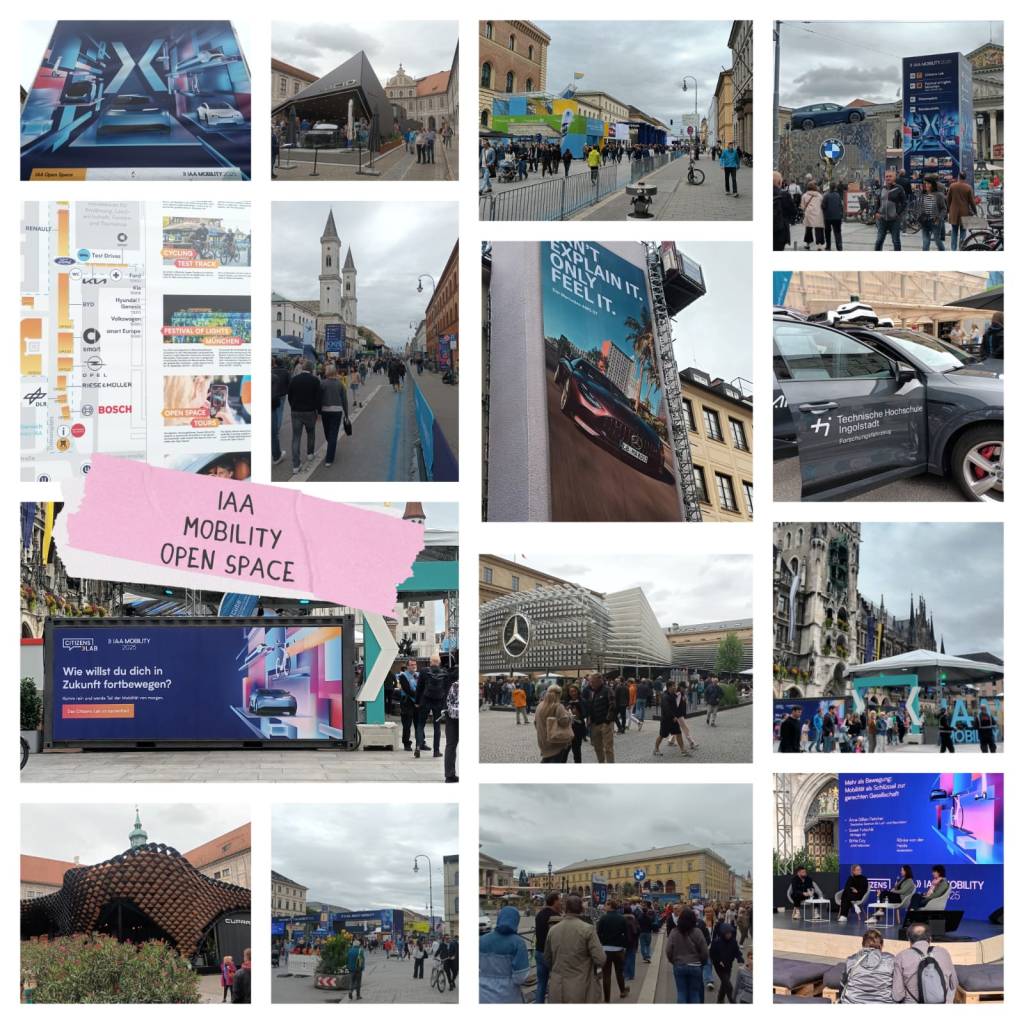
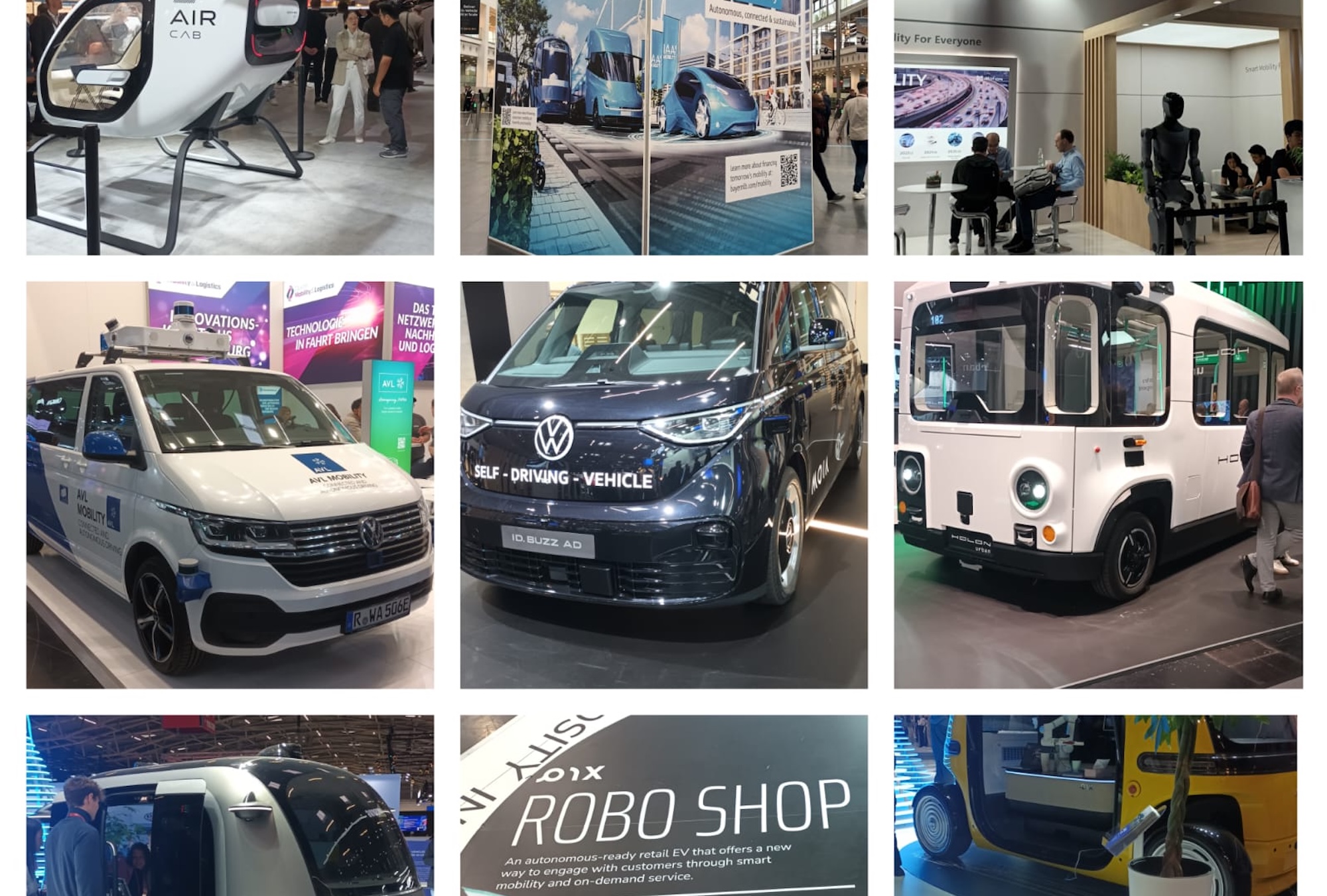
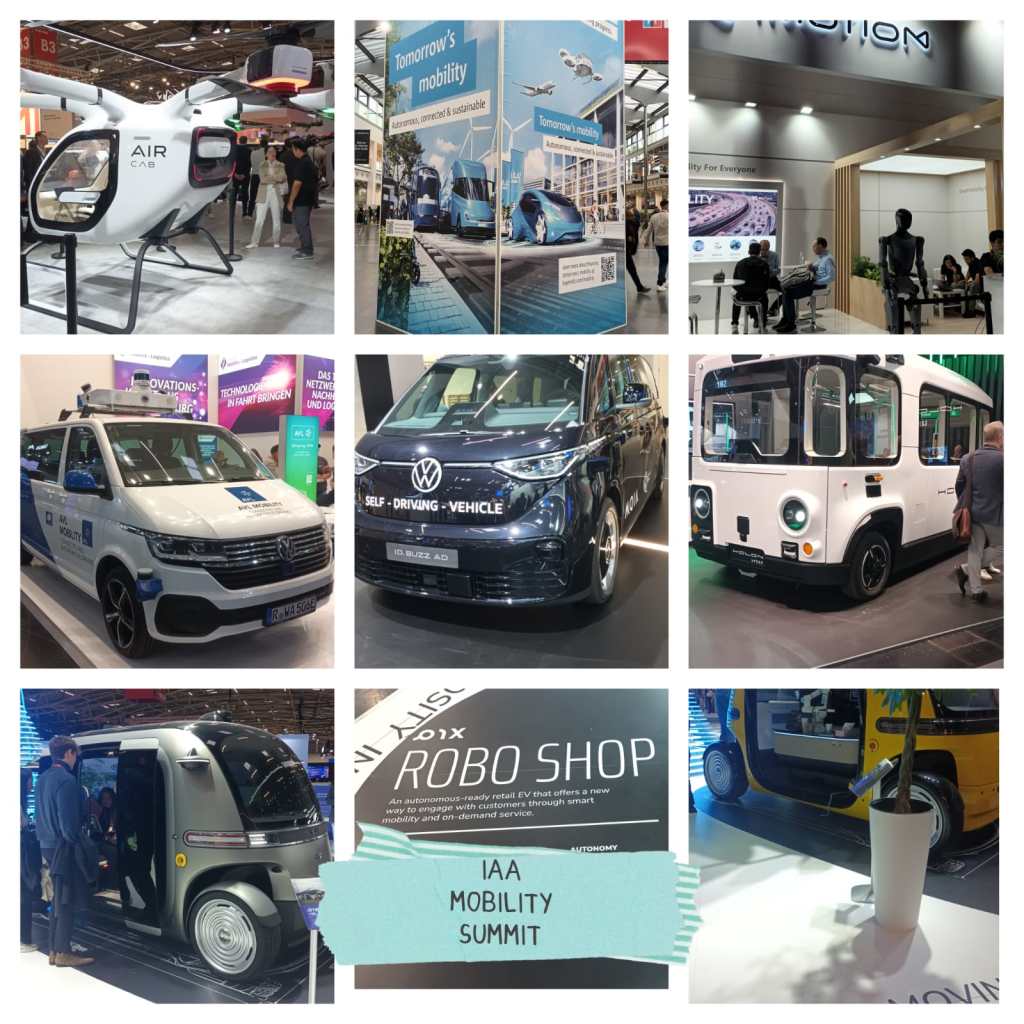
The dreary exhibition grounds on the outskirts of the city were no longer good enough for this, because private cars are needed right there – in the city center. To achieve this, a few bus routes are gladly rerouted and tram lines closed. In the spacious, multi-purpose exhibition grounds on the outskirts of the city, the Summit trade fair occupied only six halls. That’s about a third of the available space, not including the outdoor area. In addition to the main acts VW, BMW, ZF, and MAHLE, there were many Asian exhibitors. Many product names that I had never heard or read before. I would like to highlight the “QLX” stand with the products ROBOBUS and ROBOSHOP.
German/European representatives such as AVL Mobility, MOIA, Ingolstadt University of Technology, and the Technical University of Munich were represented with various test vehicles for autonomous driving.
Although buses and trucks with futuristic designs were also featured on a central advertising poster at IAA Mobility, I couldn’t spot any vehicles weighing more than three tons. At the trade fair, drones capable of transporting people were hanging from the hall ceiling. We are still a long way from that here.
Rail and public transport are also part of mobility, topics that are much discussed according to the trade fair description. I couldn’t see any corresponding eye-catching displays.
I had never experienced a trade fair with so many discussion forums and podiums. Spotlights on stages and forums were switched on and off literally every minute. Presenters and managers argued about the “role of meaning” and announced that they had found the philosopher’s stone.
I could only identify a few US companies. Google Germany and Compal USA Inc presented their software solutions, and Lucid Motors showcased its space-saving wonders. The pioneer in electric vehicle design and manufacturing was apparently not invited at all—the reasons for this are likely to be varied.
My conclusion about IAA Mobility 2025 is based purely on my subjective interpretation of reality. I saw a total of 4/5 of the entire exhibition space. I did not use any statistics.
Munich clearly won the race between Frankfurt/Main and Munich as the location. The organizers used means and methods that I cannot substantiate with facts. In any case, they succeeded in misusing Munich’s city center as a mega marketing show for everyone in order to keep old strategies marketable under the guise of electric mobility, which was recognized late in the game.
Cars are becoming increasingly powerful, larger, and heavier. Electric drives have found their place, but it is also clear that major brands continue to focus on combustion engines, sports cars, and irrationality. This presentation fails to address the long-term goal of reducing traffic in city centers by reducing the number of privately used cars. So far, a rethinking of mobility has only taken place in peripheral areas. E-bikes, cargo bikes, and micromobility are a few examples of this. I did not see any presentations from car rental or sharing companies.
The fascination with owning a car remains unbroken here. The public, which just a few years ago turned up its nose at electric mobility, is now flocking to the very same formats that were powered by combustion engines just yesterday. The main thing is that the steering wheel is always within reach.
It will be a difficult undertaking to make human reason a reality.
This article was also published in German.

 The Last Driver License Holder...
1 Comment