Every year, one million people worldwide die in road traffic accidents and between 10 and 12 million are injured. In the USA, for example, more than 39,000 people died in 2024. In the UK 1,633, in France 3,432 and in Australia about 1,300. In Germany, the figure was 2,770, in Austria 349 and in Switzerland 250.
The economic damage caused by lost productivity and medical expenses is enormous. In the New York Times, neurosurgeon Jonathan Slotkin analyzed the costs for the United States. The medical costs and the loss of quality of life for those affected are estimated at one trillion dollars, an amount that is higher than the military and health budgets combined.
Car accidents are the second leading cause of death for children and young adults in the United States, claiming more lives each year than murders, plane crashes, and natural disasters combined.
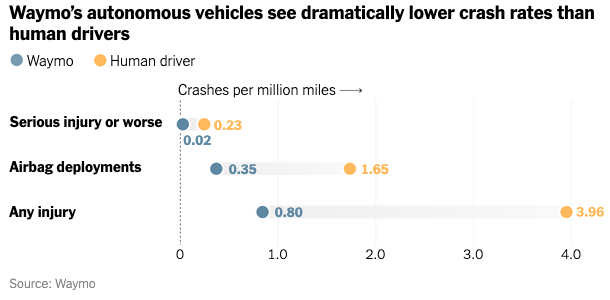
The figures reported by Waymo are clear. Compared to human drivers, there is a 91% reduction in injuries, 79% fewer airbag deployments, and 80% fewer accidents involving injuries.
The reasons why autonomous vehicles are safer are obvious. A system that follows rules, avoids distractions, sees in all directions, and prevents conflicts at high speeds will prevent fatal collisions much more frequently.
Breakthrough in Public Health
Even though autonomous cars are far from perfect, Jonathan Slotkin comes to only one conclusion in the New York Times: Waymo is a breakthrough in public health.
In medical research, there is a practice of terminating a study prematurely if the results are too striking to ignore. We terminate a study if unexpected harm occurs. We also terminate it if the benefits are overwhelming, if a treatment works so well that it would be unethical to continue administering placebos. When an intervention has such a clear effect, you change your approach.
Slotkin therefore says that it is essential for public health reasons to press ahead quickly with the introduction of autonomous vehicles. He is therefore calling on legislators to push ahead as quickly as possible with all measures to get autonomous cars on the roads and make them a legal requirement, rather than blocking them, as is currently the case in Boston and Washington D.C.
Based on the current state of technology, one could even say that with every delay in the introduction of life-saving traffic safety technology such as autonomous cars, legislators and regulators are complicit in every additional traffic fatality. Anything else would be unethical, as in the case of medical research.
Past Debates on Road Safety
The debate surrounding the safety of autonomous cars is reminiscent of another safety feature: the seat belt. This video from the UK in 1983 shows how the debate about its purpose and usefulness took place at the time and what arguments were put forward for and against it.
And here about the seatbelt ordinance in the US in 1984, which was also discussed controversially.
And Alberta in 1989 was a judge who ruled the seatbelt law unconstitutional.
This article was also published in German.

 The Last Driver License Holder...
2 Comments