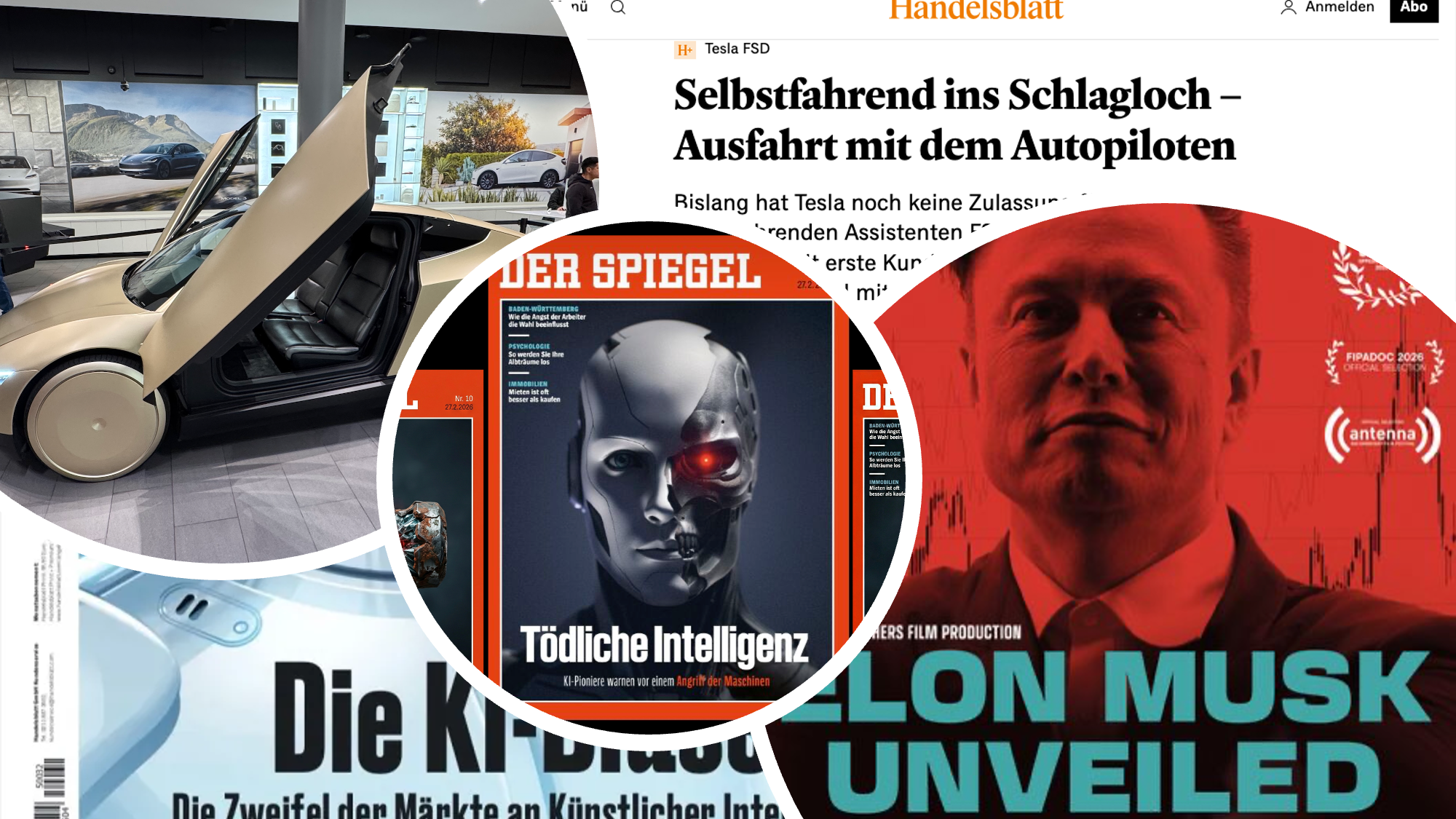
As early as late 2025, German mobility influencers and enthusiasts were sharing their first experiences with Tesla’s Full Self-Driving software, which they had the opportunity to test firsthand during drives through German cities. The reactions ranged from shock to enthusiasm. Many admitted that while they had already seen FSD videos online and knew how it worked in the U.S., skepticism remained. It was hard to believe that it would work in Germany as well, given the completely different road conditions. But videos are one thing; experiencing FSD firsthand is quite another. And the enthusiasm was palpable, as was the shift in mindset. For years, we were told it would never work, and experts cited all sorts of reasons why it could never succeed. I myself have published several analyses on this topic over the years.
Reports of positive experiences with the FSD keep coming in. Astonished accounts of the software’s capabilities are emerging from Frankfurt, Düsseldorf, Munich, and other European cities. All of these test drives were conducted with a safety driver who retained full oversight—or “supervision”—of the vehicle. But drives ranging from half an hour to an hour through narrow streets and heavy traffic with pedestrians—which the FSD handles with ease—provide valuable insights and build confidence.
The bottom line: yes, this is good, and it’s highly likely that this is the future. No doubt about it.
Here are a few reports I’ve randomly selected from LinkedIn posts:
- Sven Fillinger in Frankfurt
- Marius Räsener in Frankfurt
- Vanessa Lisa Oelmann in Stuttgart
- Christian Lieu in München
- Alexander Schönmann in München
- Josef Reitberger von CHIP in München
- Martin Otterbach in München
- Andreas Moosburg in Düsseldorf
The list could go on and on.
How does a German daily newspaper—one that boasts of having what is arguably the best AI team in the German media landscape—react? They’re dismissive, respond negatively, and don’t believe in it. This was the headline in the Handelsblatt on January 8, 2026: “Driving into a pothole on autopilot.”
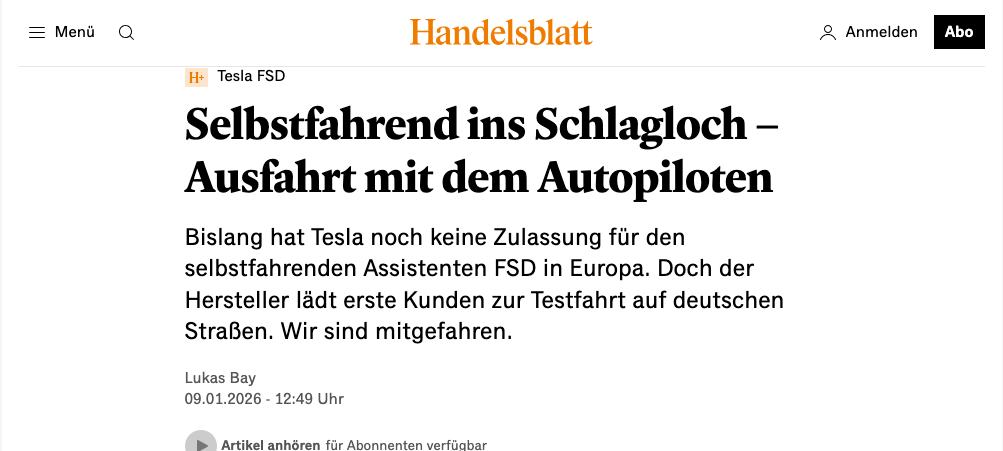
The reaction was snarky because Tesla hadn’t offered the Handelsblatt a test drive itself, forcing them to resort to undercover reporters. Lukas Bay, a Handelsblatt reporter, writes:
I didn’t receive an official press invitation, so I’m coming as a customer.
In the same paragraph, the author discredits the reports on LinkedIn by lumping them all together:
However, numerous influencers—some of whom might be said to have a certain emotional attachment to Tesla—had already posted their first test drives with the system by the end of 2025—and, as expected, were enthusiastic. No wonder, since they often earn their money through referral links that give them a cut of the sales. We’re stepping in to conduct a neutral test.
Wow! That’s really bold coming from an author who writes for a newspaper for which the automotive industry—with its advertisements—is one of the main sources of revenue—and, wait for it—Tesla isn’t included, because the Americans don’t run print ads. And then there’s the unsubstantiated claim that influencers are making money off of this.
Let’s set the record straight for Lukas Bay, because he probably doesn’t write articles like that in the Handelsblatt just because he’s kind-hearted and lives on air and love:
However, numerous Handelsblatt journalists—some of whom might be accused of having a certain emotional affinity for German automakers—have been publishing test drive reviews of the latest models for years now—and, as expected, are enthusiastic about them. No wonder, since they often earn their living thanks to the advertisements in the print and online editions, which pay their salaries.
In general, coverage in the Handelsblatt—as well as in other German media outlets—of anything related to AI is predominantly negative. The most recent example was this cover story in Der Spiegel:
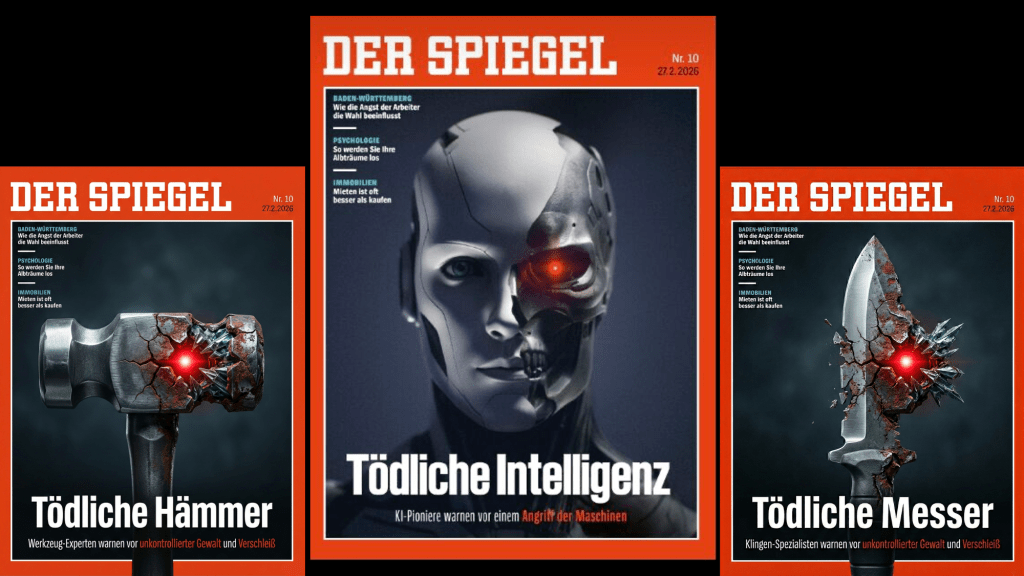
The Handelsblatt has particularly stood out—as we recall, the same newspaper that boasts of having the best AI team in the German media landscape. Yet a sentiment analysis examining how positively or negatively the topic—in this case, AI and autonomous driving—is covered yields a clear result: 60 to 90 percent of the text content is assessed as negative.
A year and a half ago, I conducted such an analysis based on reports in the Handelsblatt, and it was frustrating. Here is my quote regarding autonomous driving with Waymo in San Francisco, which examines the report by Handelsblatt correspondent Stephan Scheuer:
In an article published a year ago titled “What a Robotaxi Test Ride Reveals About Autonomous Driving,” Stephan Scheuer, then a Handelsblatt correspondent based in San Francisco, describes his personal experiences during his 12 rides in a driverless Waymo robotaxi. After a few introductory remarks on the technology, which make up about a quarter of the text, the experience report follows. And ChatGPT has this to say about it: Result: 30% positive, 70% negative
It should be noted that anyone who reads Stephan Scheuer’s text carefully will quickly realize that the problems he mentions are minor issues—things you wouldn’t even notice or criticize while driving. And in the end, the author draws a rather positive conclusion, which is not at all reflected in the preceding paragraphs.
The Handelsblatt isn’t the only German media outlet that always sees a fly in the ointment and the imminent collapse of civilization. manager magazin and the aforementioned Spiegel join in as well.
In any case, Felix Holtermann, the Handelsblatt’s US bureau chief, took the cake when he concluded in a LinkedIn-post:
Over the past four years, few topics have occupied my attention more than the technology behind Tesla’s #Autopilot. I’ve spoken with researchers and experts, with Musk’s competitors and fans, with current and former employees, and with the families of victims. The conclusion was clear: Tesla’s approach of relying solely on cameras and omitting other sensors is unsafe without driver supervision, cannot be approved—and puts lives at risk.
That reminds me of Clarke’s First Law, which states:
If a respected but elderly scientist claims that something is possible, he is almost certainly right. If he claims that something is impossible, he is most likely wrong.
It also reminds us of statements made about other technologies, such as those in The New York Times in 1993
On October 9, 1903, The New York Times published an article titled “Flying Machines Which Do Not Fly,” in which it was soberly claimed that it would take another 1 million to 10 million years before we could build a flying machine. Sixty-nine days after the article’s publication, Orville and Wilbur Wright took off in a controlled manner for the first time with their Flyer and flew 37 meters for 12 seconds.
What did Albert Einstein once say when a critique of his theory of relativity titled “One Hundred Authors Against Einstein” was published?
If I were wrong, a single author would be enough to disprove me.
What else have we heard from “experts”:
- Speeds over 30 km/h are fatal to humans
- Conditions such as “Bicycle Face,” “Aeroplane Face,” and “Elevator Sickness”; at speeds over 30 km/h, a woman’s uterus flies out of her body,
- the Internet will not become a mass medium (Matthias Horx, 2001)
- the automobile will not prevail
- the electric car will not prevail
- autonomous cars will never exist (Germany still)
- and now the variation
- the autonomous car based on Tesla’s approach will never exist
So if Felix Holtermann, the Handelsblatt’s US bureau chief, and his experts were right, then a single expert would be enough to refute Tesla. This repeated claim—that Tesla’s FSD is unsafe without driver supervision, cannot be approved, and endangers human lives—will not stand the test of time. One can repeat this claim until it is no longer true.
Meanwhile, the German media landscape, with the Handelsblatt at the forefront, is doing German society and industry a disservice. They lull them into a false sense of security, downplay developments in China and the U.S., lull Germany into a false sense of security, and then comes the rude awakening. The reactions of Tesla FSD testers in Germany are the best example. They believed the media reports and the negative coverage until they came into contact with the technology themselves. And now they feel pretty much lied to and screwed over.
This is how we’re screwing our future, and the German media bear a significant share of the blame.
This article was also published in German.

 The Last Driver License Holder...
1 Comment