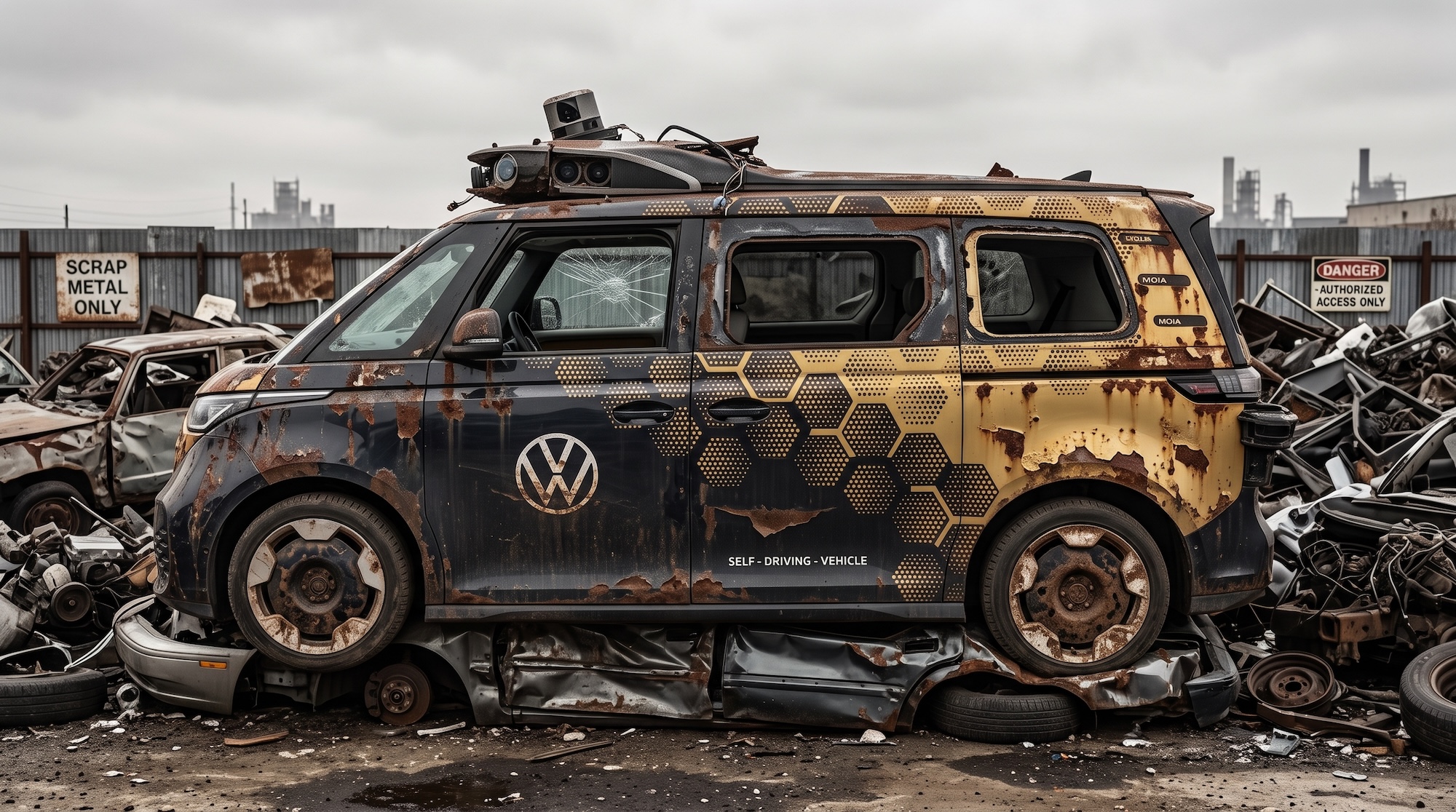
Rumors are swirling after VW CEO Oliver Blume had to admit that the last two potential investors in MOIA have also pulled out. VW had held talks with Uber and Lyft, among others, but in the end, not a single potential partner came on board.
More than a year ago, I wrote a detailed analysis of MOIA and its timeline, which struck me as quite unrealistic—a view that was privately confirmed to me. Further undermining this timeline was the fact that, on the one hand, MOIA discontinued its ride-hailing service in Hanover shortly thereafter, thereby losing a test area with users familiar with the service, and, on the other hand, VW had announced plans to sell shares in MOIA. All of these sales talks have now fallen through.
Why did they burst? There are probably several reasons for this:
- MOIA does not own the core technology—namely, the autonomous driving system. That comes from Mobileye, which determines the pace of further development and how much money is invested in it.
- The timeline calling for the first driverless trips by the end of 2026 already seemed unrealistic a year ago, as I analyzed in detail.
- VW did not want to invest the proceeds from the sale of its shares into MOIA itself, but rather to use them to bolster its own balance sheet. This undermines the confidence of new partners when even VW is no longer willing to invest money in the project.
- Stability of the leadership team at VW. During the same period from 2009 to the present—the time in which Waymo developed its self-driving technology—VW’s CEOs changed every 2–3 years. The temptation for any CEO to cut development costs for an autonomous driving system—ranging from several hundred million to one billion per year—is simply too great. Moreover, it’s unlikely that they themselves will reap the rewards—rather, it will likely be the third or fifth CEO after them. Given the immense pressure VW has been under—not just for the past few weeks, but which has intensified massively in recent months—the conditions are hardly conducive to building trust among new investors.
What do you think will happen next? I basically see only two options:
- Pull the plug on MOIA, just as VW did with Argo.ai almost exactly four years ago, after investing several billion.
- Sell MOIA to a competitor, such as BMW or Mercedes, with the acquisition of employees and technology, and even a few hundred million in additional investment to retain a stake in the company (a model similar to the sale of Uber ATG to Aurora).
One thing that probably won’t happen is continuing to support MOIA and letting it carry on. That’s because the realization that we can’t compete in this technology sector has set in—especially with the news about Waymo, which is launching a robotaxi service in one city after another almost every week. It’s a shame, really.

HOMO SYNTHETICUS
Wie Mensch und Maschine verschmelzen
Künstliche Intelligenz wird sichtbar. In „Homo Syntheticus“ beschreibt Zukunftsforscher Dr. Mario Herger den Aufbruch in ein neues Zeitalter, in dem Maschinen nicht mehr nur denken, sondern fühlen, handeln und lernen. Humanoide Roboter mit künstlicher Haut und autonomem Bewusstsein treten in unser Leben – als Helfer, Kollegen, vielleicht Partner. Gleichzeitig erweitern wir Menschen uns selbst: durch Implantate, Schnittstellen und KI im Körper. Mensch und Maschine nähern sich an, verschmelzen – und stellen unsere Vorstellung von Identität, Ethik und Fortschritt auf die Probe. Ein faszinierender Blick auf die Ära des synthetischen Menschen.
This article was also published in German.

 The Last Driver License Holder...
1 Comment