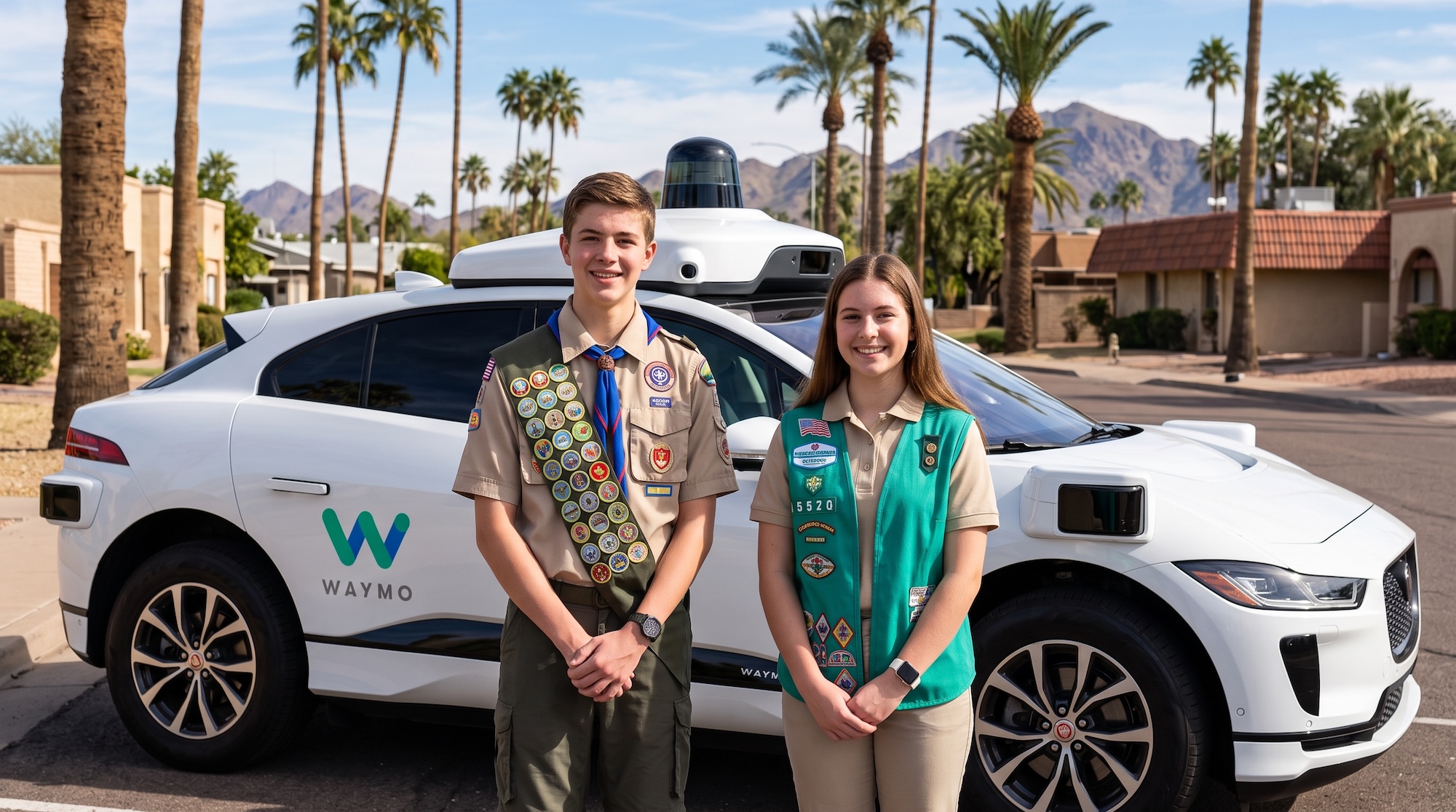
In regions with little or no public transportation—as is often the case in large parts of the U.S. outside major cities—having a driver’s license and a car is essential for getting to school, a training center, or simply to visit friends. The “parent taxi” is often the only means of transportation available to children. Furthermore, U.S. cities are designed in such a way that even riding a bike is neither possible nor safe enough. For one thing, there is a lack of bike lanes—and often even sidewalks—and the distances are simply too great; or the weather and terrain make biking impossible.
A study in Phoenix, Arizona, followed 30 teenagers between the ages of 14 and 17 for one summer and examined the stress levels of the participants as they tried to arrange transportation to their summer jobs with the Boy Scouts and the
Boys & Girls Clubs of the Valley (BGCAZ). Cycling in Phoenix, Arizona, is not feasible for two reasons: summer temperatures in this desert region consistently exceed 40 or 45 degrees Celsius, and the distances are simply too great in a city designed for cars but not for bicycles.
Half of the teenagers received vouchers that allowed them to use Waymos for free; the other half had to arrange their own transportation. In the summer of 2026, Phoenix was the only major city where Waymo allowed teenagers to have an account to use the robotaxis. Both before the study began and after it ended, the teenagers and their parents filled out a questionnaire in which they could, among other things, provide information about their stress levels related to arranging transportation.
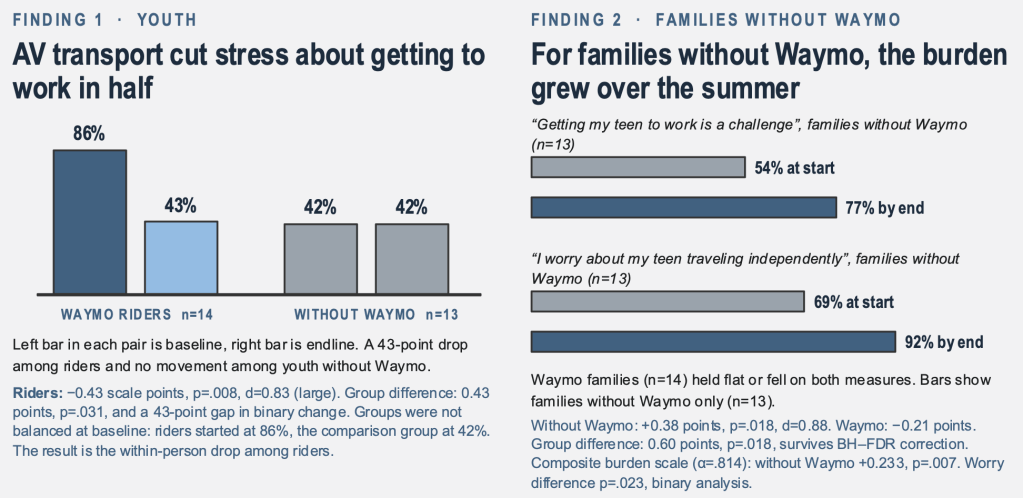
A clear pattern emerged. The teenagers with access to Waymos saw their stress levels cut in half. By the end, they were much less stressed than before. At the same time, while the teenagers and parents without access to Waymos did not notice any change in stress levels, parents felt more anxious when their children could not use the “parent taxi”—which was already stressful enough—and had to arrange their own transportation independently of them. This stress level actually increased.
There were no incidents during the 539 rides with Waymo; each teenager took an average of 36 rides with Waymo, and the rides cost $539 per teenager over the period, or $16.50 per ride. The average wait time for a Waymo was 9.6 minutes.
Click here for the study: Short version | Long version
Legacy Institute originated and designed the pilot and commissioned the independent evaluation. The AV Youth Mobility Pilot was funded by Legacy Institute and the Donnell-Kay Foundation. It was made possible by the staff and families of Boys & Girls Clubs of the Valley. The evaluation was designed and conducted independently by Radiant Global Insights. Waymo provided trip -level data and operational support, but no financial support to Legacy Institute,
This article was also published in German.

 The Last Driver License Holder...
1 Comment