Many years ago, when Waymo was still called Google Self-Driving, Steve Mahan, president of the American Council of the Blind, had the opportunity to ride in a driverless car in Austin. Even when Waymo finally received approval for commercial driverless operations in California, the American Council of the Blind was one of more than 80 co-signatories supporting Waymo.
In recent months, there have been numerous examples of other groups benefiting from Waymo. Women have felt much safer, and people on the autism spectrum have gained an additional level of independence that is tailored to their needs, without being overwhelmed by too many sensory stimuli.
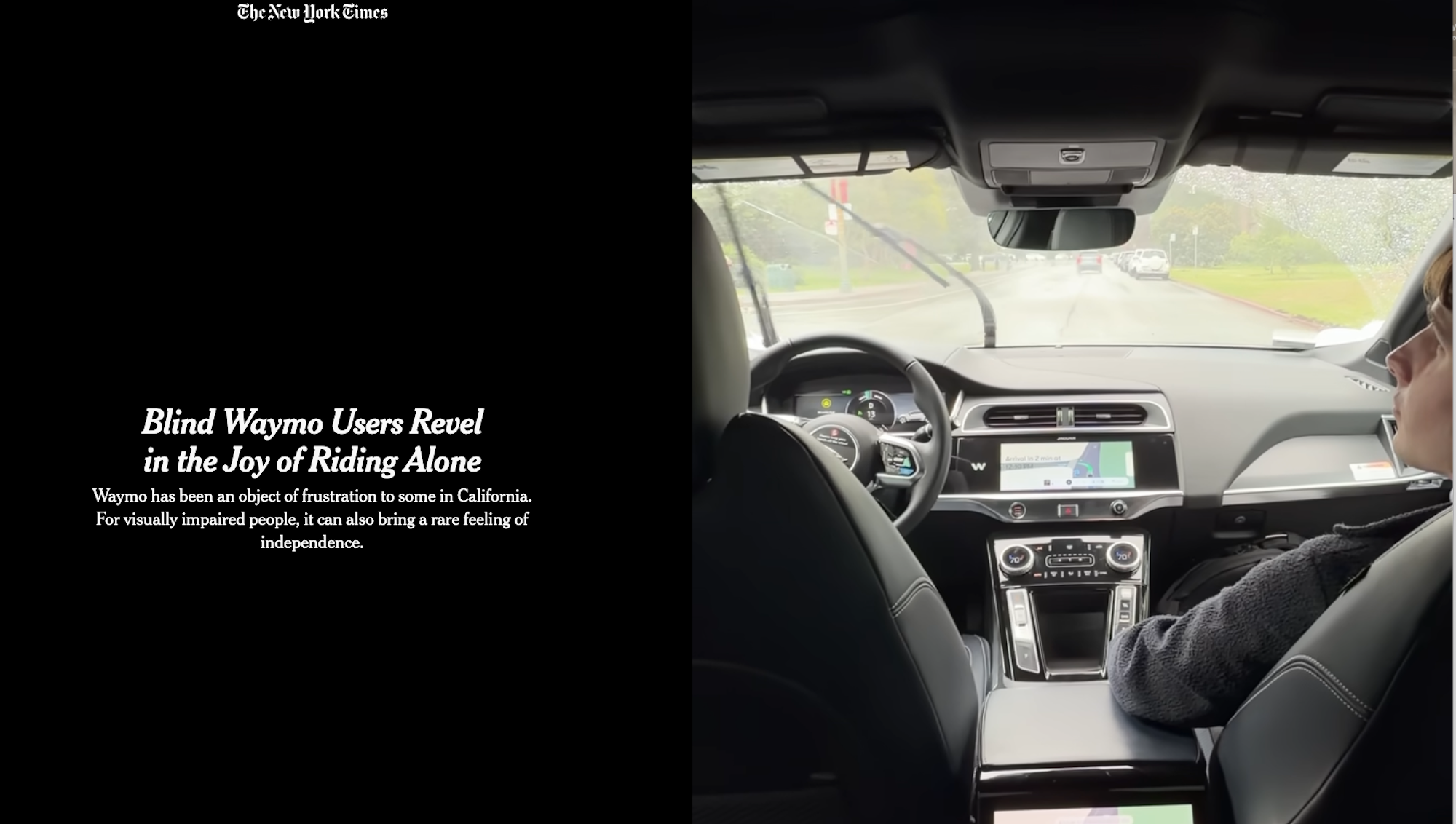
Now, the renowned New York Times follows up with the article “Blind Waymo Users Revel in the Joy of Riding Alone” Using the example of 28-year-old Ruben Brunt, who was born with a rare eye condition, the NYT explains why Waymo is such a blessing for Brunt.
It’s that feeling of independence and actually having the control. [..] Being able to play whatever music you want, feeling like you’re in your own car.
“II don’t have to talk to another human being,” said Sarah Funes, a resident of South San Francisco who is partially blind and partially paralyzed due to a brain tumor. “get in a car, and I’m just alone.”
Waymos also do not discriminate. Time and again, visually impaired people find themselves denied rides in taxis or Ubers because the driver refuses to allow their guide dog on board, even though they are legally required to do so.
The only downside is the still-high prices charged by Waymo; otherwise, Brunt and Funes would use them every day.
Click here for the full article in The New York Times.
This article was also published in German.


1 Comment