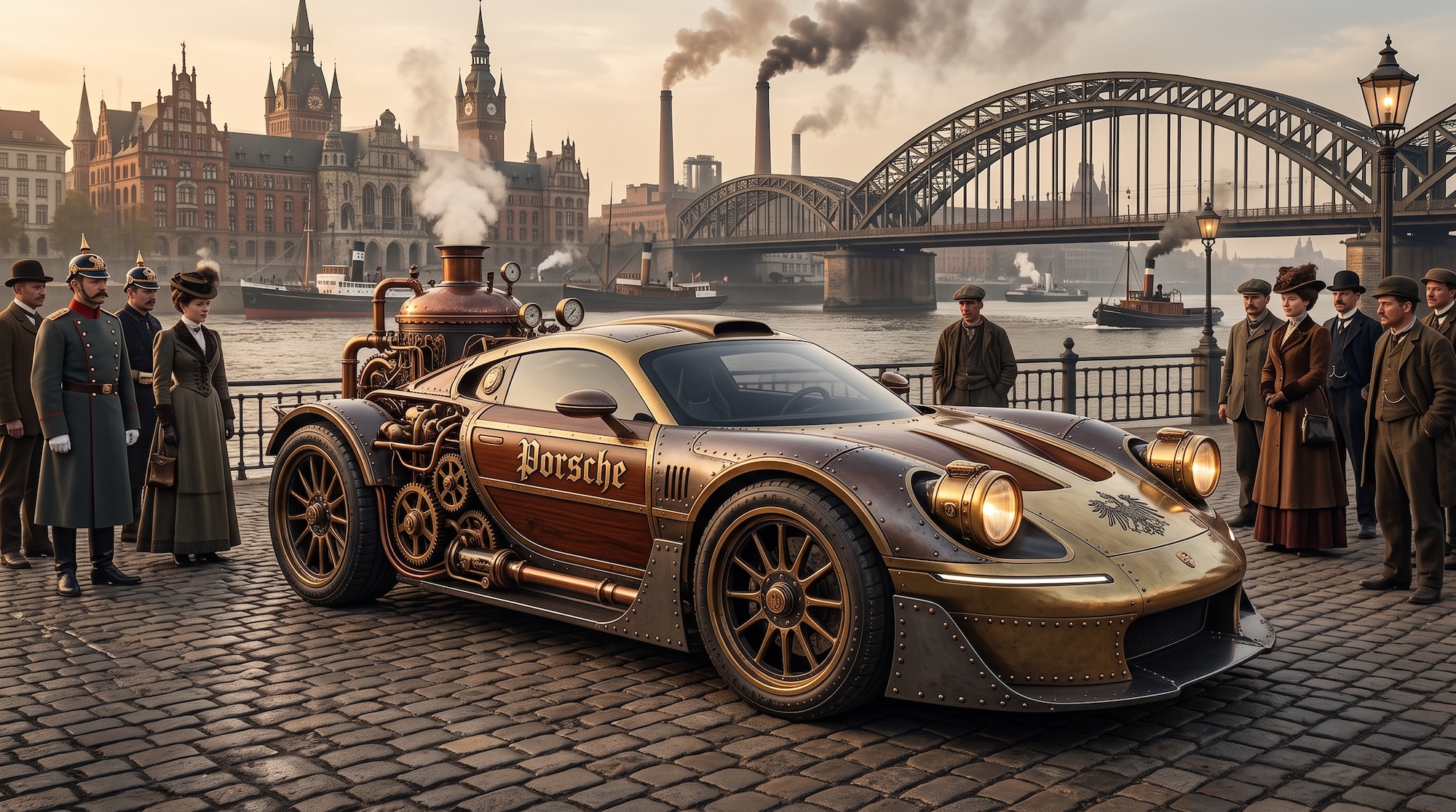
With the nearly simultaneous unveiling of the Porsche Mission S and the Tesla Roadster, a debate has erupted in Germany over just how innovative and progressive German automakers really are. While Porsche receives vehement support from enthusiasts and fans, others see Porsche as a prime example of the decline of a prestigious German automaker because it fails to understand the future and has given up on helping to shape it.
On the Situation at Porsche
Porsche has suffered dramatic declines in sales and revenue in recent years. The drop in profits in 2025, for example, was over 90 percent—from more than €3 billion in 2024 to €310 million in 2025. In 2026, a 16 percent decline in revenue has already been recorded, even though profits are expected to have risen again, though they remain far below the 2024 figures.
This is due in no small part to the fact that Porsche’s existing customer base rejects electric cars, and in China, an initial Porsche craze has given way to disillusionment since Chinese manufacturers began offering cars on par with Porsche—with more power, more attractive designs, better digital features, and lower prices. Porsche’s market capitalization has fallen to €37 billion, down from €120 billion in 2023.
Similar behavior among the core customer base was also evident at the iconic motorcycle brand Harley-Davidson, which failed to make an impact with the electric version of its motorcycle because Harley-Davidson riders missed the sound above all else, and the Milwaukee-based manufacturer was unable to attract new customer segments. Today, the core customer base consists primarily of white men over 50 with white beards. And, like Porsche’s customer base, they are slowly dying out.
What Tesla Showed
Tesla, for its part, unveiled the second generation of the Roadster, which was first announced in 2017 and is now scheduled to go into mass production in 2028. The Roadster’s unveiling was arguably the craziest display ever seen for a car. The vehicle drove up a wall, hung upside down, did a somersault, and landed gently on the ground from a height of 10 meters. Then, like KITT from the TV series Knight Rider, it leaped over five cars without a ramp—using its compressed-air jets—while performing a roll, and accelerated from 0 to 60 miles per hour in less than a second. A car that pushes boundaries and demonstrates innovative concepts by breaking through industry limits. A top-class feat of engineering that reimagines the automobile.
If you didn’t see the unveiling of the Tesla Roadster, here’s a highlight reel:
What Porsche Showed
What did Porsche showcase? The Mission S, which—as its most “innovative” features—once again boasts an internal combustion engine (no kidding!), a manual transmission (what a joke!), and (also no kidding) absolutely no digital elements like touchscreens or anything like that. Instead, the analog gauges, the analog knobs to turn and push, and a retro design are touted as the pinnacle of German engineering innovation, evoking Porsche’s history and appealing to the nostalgia of buyers nearing retirement.
Why? Because they’ve failed with their own electric car strategy. Porsche didn’t bring a sufficiently ambitious electric sports car to market—one that pushes boundaries, redefines sports cars, and attracts new, younger buyer demographics.

HOMO SYNTHETICUS
Wie Mensch und Maschine verschmelzen
Künstliche Intelligenz wird sichtbar. In „Homo Syntheticus“ beschreibt Zukunftsforscher Dr. Mario Herger den Aufbruch in ein neues Zeitalter, in dem Maschinen nicht mehr nur denken, sondern fühlen, handeln und lernen. Humanoide Roboter mit künstlicher Haut und autonomem Bewusstsein treten in unser Leben – als Helfer, Kollegen, vielleicht Partner. Gleichzeitig erweitern wir Menschen uns selbst: durch Implantate, Schnittstellen und KI im Körper. Mensch und Maschine nähern sich an, verschmelzen – und stellen unsere Vorstellung von Identität, Ethik und Fortschritt auf die Probe. Ein faszinierender Blick auf die Ära des synthetischen Menschen.
While Elon Musk continues to raise the bar for his engineers even during the Roadster’s unveiling—“The top speed should be half the speed of sound,” “We want to recreate Evel Knievel’s stunt jumping over Snake River Canyon,” and “We can certainly make the 0-to-60 even faster—where the limit is simply the speed at which the retina detaches from the driver’s eye”—thereby spurring them on to engineering excellence—Porsche, meanwhile, draws on the past.
Porsche worships the ashes instead of carrying the flame forward.
The difference is evident in market capitalization. At €1.25 trillion, Tesla is valued at 34 times that of Porsche; even at Porsche’s peak market cap of €120 billion, Tesla was still worth ten times as much. Market capitalizations are often described as out of touch with reality, and critics are quick to argue that Tesla is “overvalued.” Yet stock prices and market capitalizations are indicators of how confident investors are that a company is performing well in existing markets and whether it can tap into new ones. A company like Porsche, which, in an act of desperation, must rely on past successes, tries to keep old technology alive under a new guise, and is even taking steps backward in design and usability, is not tapping into new markets. It is serving old, shrinking markets. But what good is it to capture a large share of a market that is inexorably heading toward zero? One hundred percent of zero is still zero.
Meanwhile, Porsche fans rush to the company’s defense with preposterous arguments.
- Porsche delivers what it promises! (Good electric sports cars?);
- Porsche has been incredibly successful in racing history (So what? How does that translate to the future?);
- Porsche makes cars that are legal for the road, not flying cars that would never be approved (Porsche plays by the rules, while Tesla is reinventing the game and creating new playing fields. Who do you think is more innovative?);
- Who needs flying cars like that? Porsche makes cars for the road! (Tesla is opening up new possibilities by breaking down barriers between industries and creating synergies that didn’t exist before. For example, the suction jets allow for faster and more stable cornering; the jets help with acceleration, stabilization in corners, and braking…);
- Flying cars don’t make sense, and nobody needs them (nobody really needs sports cars either, especially not on public roads; there’s no social benefit to sports cars either).
By the way, the reactions were brutal. Dozens of memes have already popped up, and Porsche is really getting roasted.
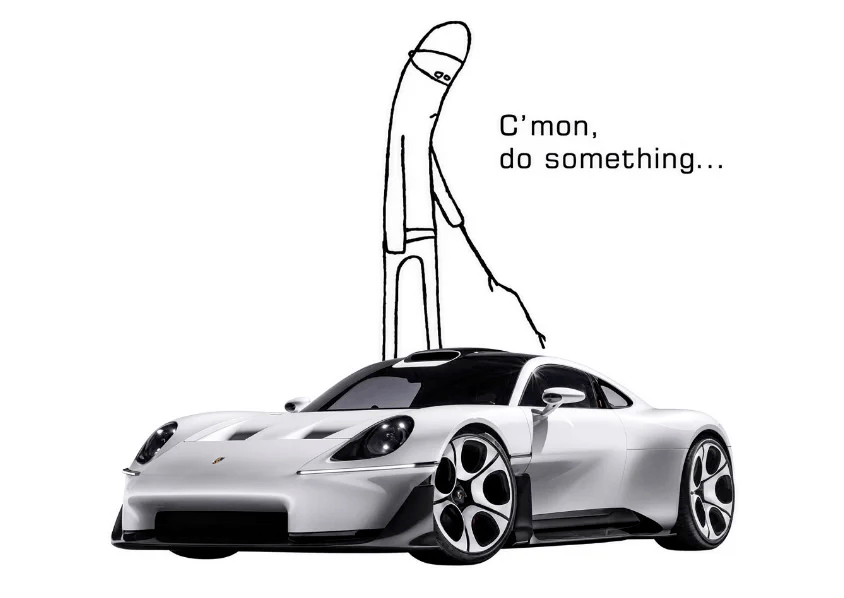
To be fair, people are already making fun of the Tesla Roadster, too, but there’s an undeniable sense of admiration for its craziness that comes through everywhere.
Anyone who has to resort to emotions evoked by outdated technology is admitting that they do not understand technological innovation.
Let’s not forget that Carl Benz, too, did not have road approval for the Motorwagen 1. There simply wasn’t a box labeled “driverless carriage” to check in the German bureaucracy of 1886. It wasn’t until Bertha Benz—the automotive industry’s first female venture capitalist, an engineer, a pioneering driver, and the driving force behind her husband, the young startup founder Carl Benz—”stole” the Motorwagen 1 without Carl’s knowledge and took it on a 112-kilometer daring journey from Mannheim to her mother’s home in Pforzheim with her two underage sons, did this “serious criminal” (driving a car without a license, endangering two minor children—her sons, acting against her husband’s wishes) bring about the automotive moment that made history. She and Carl didn’t take to it, and afterward went back to building horse-drawn carriages because that’s what the customers wanted—they wanted to experience genuine emotion and the thrill of driving with their horses, rather than with the lifeless, soulless, cold engine block and metal frame.

The German (European) Mentality
A country where the media constantly speak ill of new technologies (see the sentiment analyses of German media coverage of AI, see here), long-haired “philosophers” and other moral entrepreneurs shape the public discourse on technology in a way that gives the impression that the next technology—which, incidentally, does not originate from Germany or Europe—is threatening us, that civilization is on the brink of collapse, and that it can be saved only through radical measures and nothing else, New Year’s addresses by politicians (see those by Federal Chancellor Friedrich Merz) speak only of fears, difficult times, and uncertainties—but not (as Chinese President Xi Jinping does) of visions and progress—then we realize that this isn’t just a Porsche issue; it’s a systemic problem affecting society as a whole.

FUTURE ANGST
Wie wir von Innovationsvorreitern zu Innovationsnachzüglern wurden und wie wir die German Angst überwinden
Welche aktuellen Ängste prägen uns? Mit welchen Ängsten waren die Menschen in der Vergangenheit konfrontiert, als es die heutigen Technologien noch nicht gab? Warum mischen wir heute im Wettbewerb der Kulturen um neue Technologien nicht ganz vorne mit? Welche Maßnahmen müssen wir ergreifen, um neue Technologien nicht als etwas Beängstigendes und Feindseliges zu betrachten, sondern als ein Mittel zur Lösung der großen Probleme der Menschheit? Innovationsexperte Dr. Mario Herger stellt in „Future Angst“ die entscheidenden Fragen in Bezug auf Technologie und Fortschritt und zeigt professionelle und zukunftsweisende Lösungen auf. Mit seinem Appell „Design the Future“ bietet Herger einen unkonventionellen und transformativen Ansatz für ein neues, human geprägtes Mindset.
The paradox here is that Germany sees itself as the land of poets and thinkers, but also of the world’s best engineers. It wants to peddle its own technology to others, yet it fears technologies developed by others (from other countries).
And when it can’t do that, it desperately tries to put lipstick on old technology—like putting lipstick on a pig—and tout it as the next big thing. The pig may look prettier, but it is and always will be a pig. The Porsche Mission S may look nice, but it’s still old technology. There are enthusiasts of old technology, but they’re organized into classic car clubs, are typically elderly, and will soon pass away. That’s not a customer base you can count on for the future.
Our own technology—yay! Foreign technology—yuck!
At the same time, Germany and France are patting themselves on the back for postponing an “internal combustion engine ban” in the EU. And this despite the fact that the global trend is clear. On the one hand, gas prices are so high that anyone buying an internal combustion engine car today either has too much money or never learned math in school; on the other hand, they haven’t noticed that in September 2026, for the first time, more electric cars and hybrids were sold than internal combustion engine vehicles.
Porsche is merely a symptom of what’s going wrong in Germany (and Europe) when it comes to technological innovation. Too many people are still profiting from outdated technologies; they want to hold on to them at any cost—or at least milk them for as long as possible. To top it off, they’re even inventing new terms that sound so progressive and benevolent—“Hello, technological openness!”—and are thereby leading the country and an entire continent into technological irrelevance.
No delegations come to Germany to see how innovation happens and what the future holds; for that, people go to Silicon Valley or China. People only come to Germany to visit a museum of outdated technologies. They enjoy looking at them, feel nostalgic, wipe away a tear, and want to explain them to their children—who just roll their eyes—but given the choice, no one really wants to use them in everyday life anymore. Porsche has shown us where to go for a technology museum. Tesla shows us the future.
This article was also published in German.


1 Comment