
It’s February again, and that’s when the California DMV releases its annual Disengagement Report, or more accurately, the data that goes with it. A so-called disengagement report is required from the 31 companies currently licensed to test autonomous cars on public roads in California. This has been in place for a number of years, I have documented 2015, 2016, 2017, 2018, 2019, 2020, 2021, 2022 and 2023.
Executive Summary
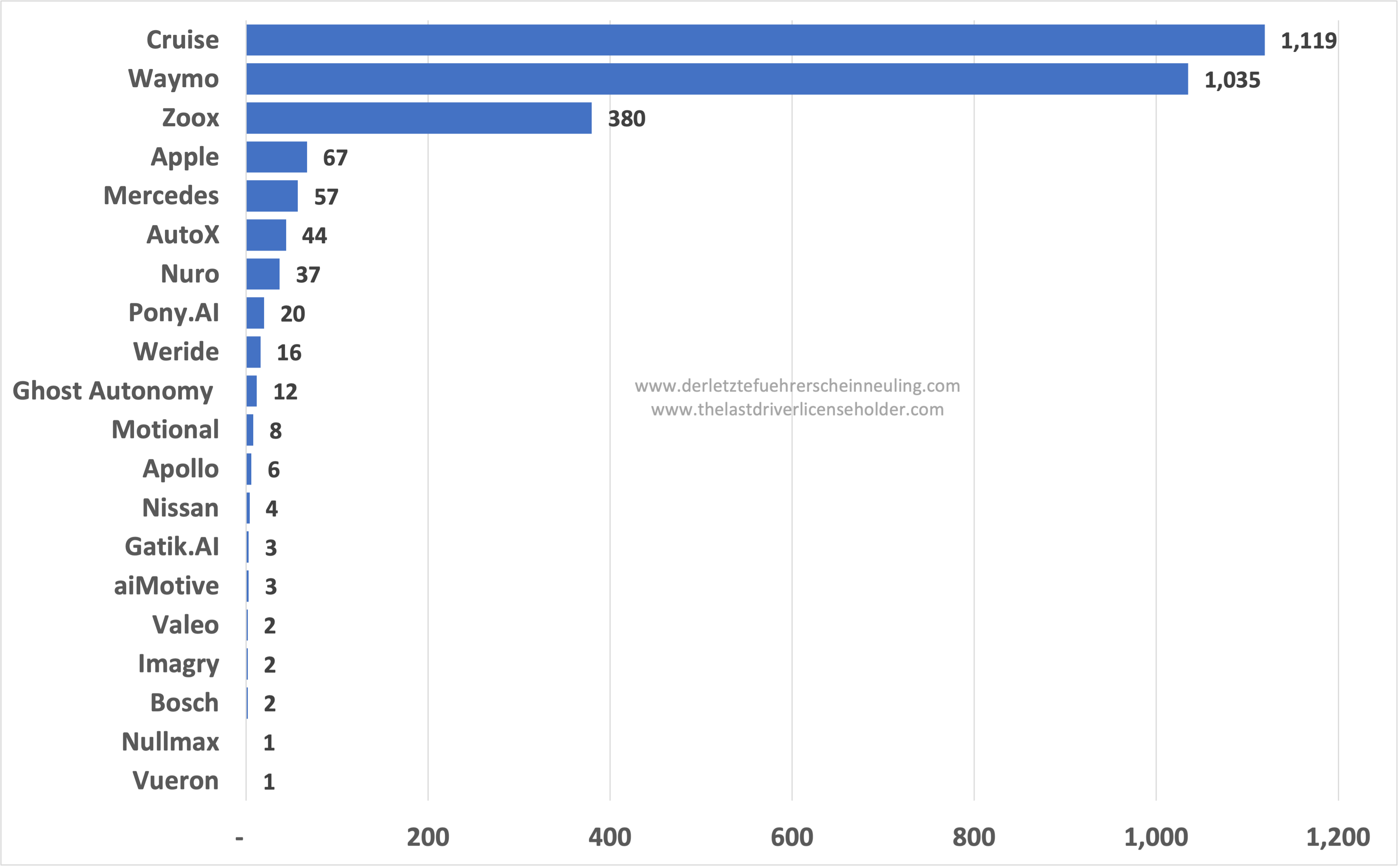
- Waymo operates 1,035 vehicles in California, an increase of 136 percent on the previous year;
- A total of 31 companies operated 2,819 autonomous (test) vehicles;
- Four companies drove 888,027 kilometers (555,017 miles) driverless;
- Apple and Cruise have discontinued their development.
Introduction
Each year, license holders must indicate how many autonomous test and commercial vehicles they had in operation from 1 December to 30 November, how many miles or kilometers they drove, and how many disengagements there were. A disengagement can be described as an event in which the autonomous vehicle either did not know what to do and handed over control to a safety driver present in the vehicle, or when a safety driver took over control themselves. The latter is the case, for example, when the vehicle was about to make a mistake or was unable to find its way out of a traffic situation.
You can already see from this definition that it is at the discretion of the licensee what is reported as a disengagement. Often, an overzealous safety driver takes control, where it turns out in the simulation that the vehicle would have handled the situation itself. Also, fewer interventions are to be expected on highways than in suburbs or in cities such as San Francisco, where there are many different road users. In this respect, the figures reported and published by the companies should be treated with caution. However, I am interpreting and presenting them anyway because California is currently the only region in the world where we have such data publicly available and they offer a small insight into the progress and status of the development of autonomous vehicles.
A total of 20 companies have reported data for the entire year (December 1, 2023 to November 30, 2024). Furthermore, 6 manufacturers (Apollo, AutoX, Nuro, Waymo, WeRide, Zoox) are still licensed to operate the vehicles without safety drivers, as in the same period last year, and three are allowed to operate them commercially (Mercedes-Benz, Nuro, Waymo).
Reports with Safety Drivers
First of all, there are the reports on driving with safety drivers in the vehicle. A total of 2,819 autonomous vehicles were in operation in California during the period, an increase of 76 percent on last year’s 1,603. Cruise had the most with 1,119 vehicles (510 vehicles in 2023, which have not been in operation since October 2024 due to the discontinuation of Cruise by GM). Waymo had 1,034 vehicles, an increase of 136 percent on 438 vehicles in 2023, while Zoox had 380, an increase of 34 percent.
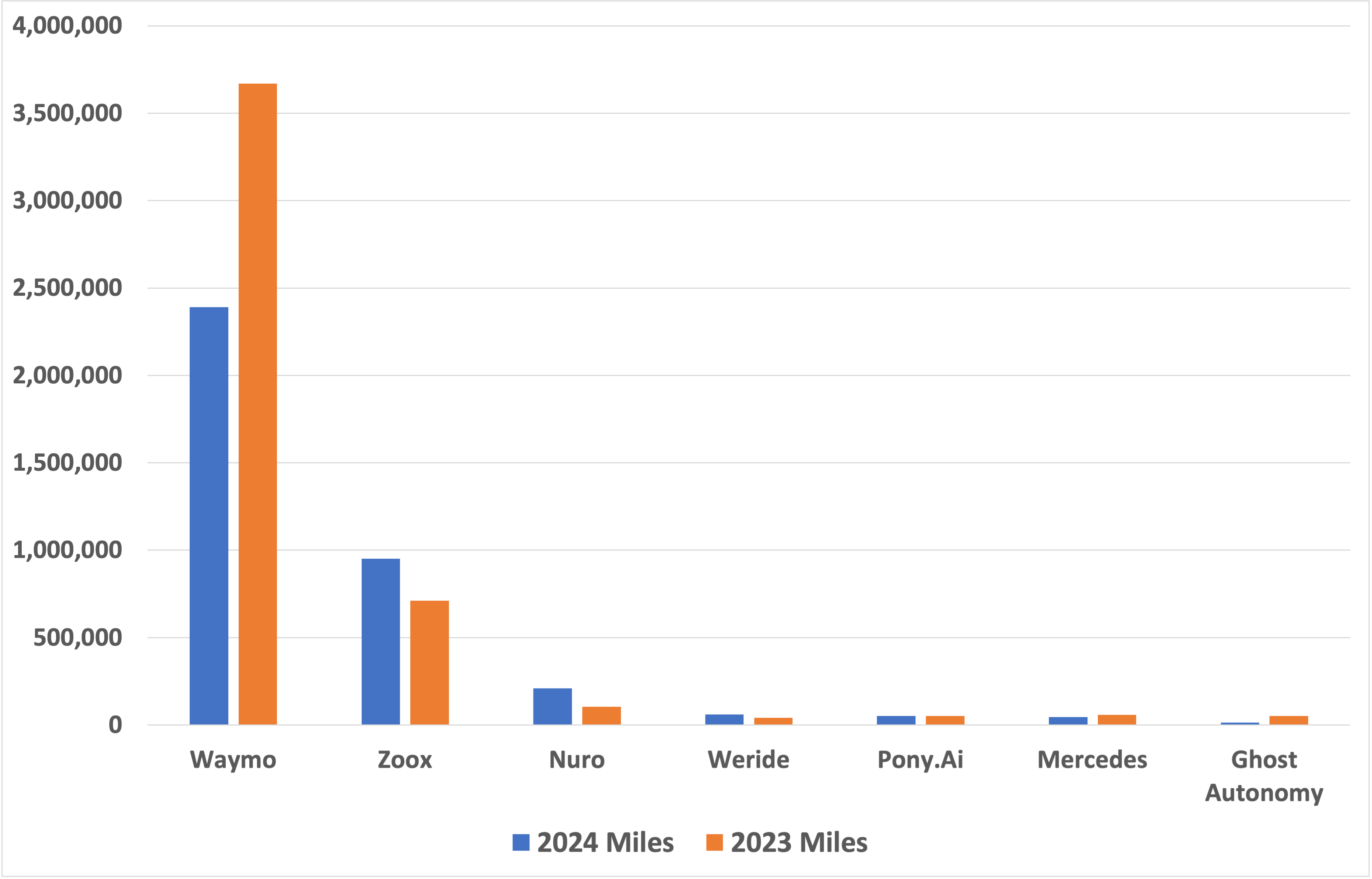
All manufacturers together covered a total of 6,260,252 kilometers (3,912,657 miles), a third less than in the previous year, when all vehicles together covered 9,282,681 kilometers (5,801,675 miles).
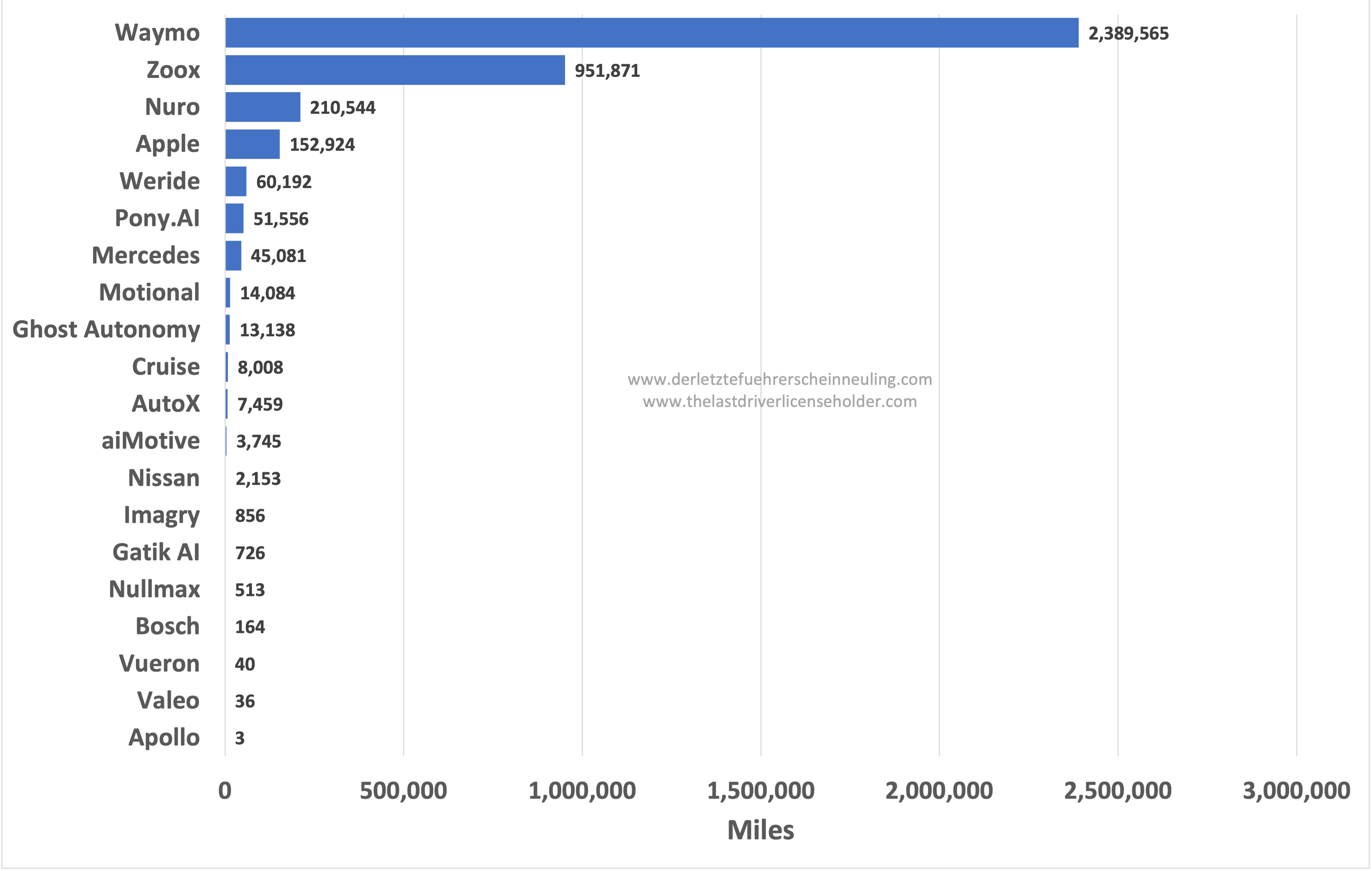
Waymo again achieved the most kilometers, driving 3,823,304 kilometers (2,389,565 miles), 35 percent less than last year’s 5,871,940 kilometers (3,669,962 miles). Zoox achieved 1,522,884 kilometers (951,871 miles), an increase of 34 percent compared to the previous year. Nuro doubled its mileage from 104,011 to 210,544, while Weride increased it by 42 percent from 42,381 kilometers to 60,192.
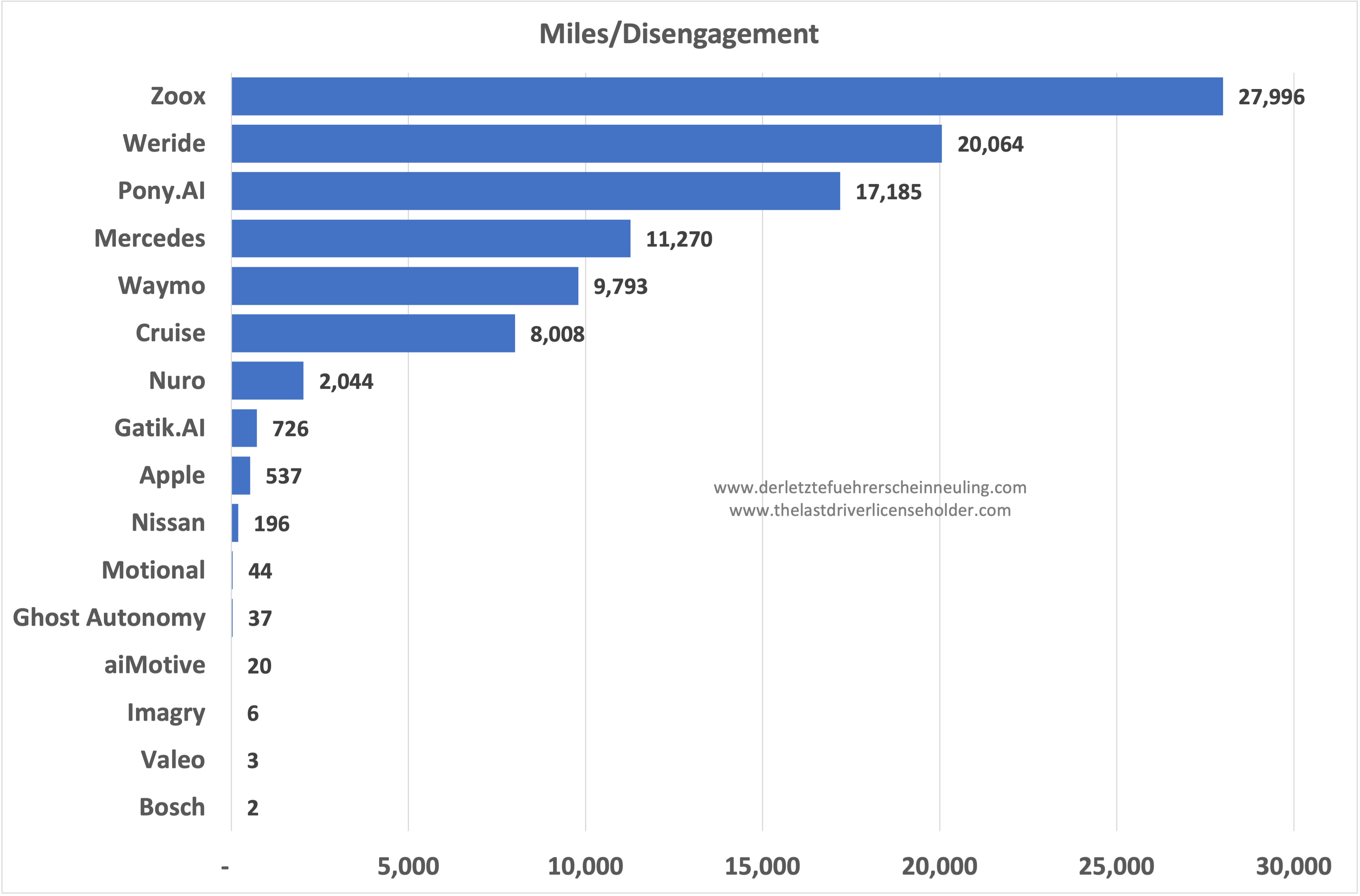
As always, the present evaluation of how many kilometers a vehicle drives autonomously before a safety driver has to intervene should be treated with caution, as the way in which a disengagement is determined is left to the companies.
First Timers
Two companies reported for the first time. These were Beep and May Mobility. Beep reported 27,306 test kilometers (17,066 miles) in safety driver mode, with 9,159 disengagements, which equates to one intervention every 2.98 kilometers (1.86 miles).
May Mobility reported 21,856 test kilometers (13,660 miles) and 20,694 engagements, which equates to one engagement every 1.06 kilometers (0.66 miles).
Driverless Reports
Six companies (Apollo, AutoX, Nuro, Waymo, WeRide and Zoox) have a driverless license and reported figures on this. In total, four of the companies (Nuro, Waymo, WeRide and Zoox) completed 888,027 driverless kilometers (555,017 miles) in the comparison period.
| Miles | Kilometers | |
| Nuro | 169 | 271 |
| Waymo | 516,572 | 826,515 |
| WeRide | 471 | 754 |
| Zoox | 37,804 | 60,487 |
| 555,017 | 888,027 |
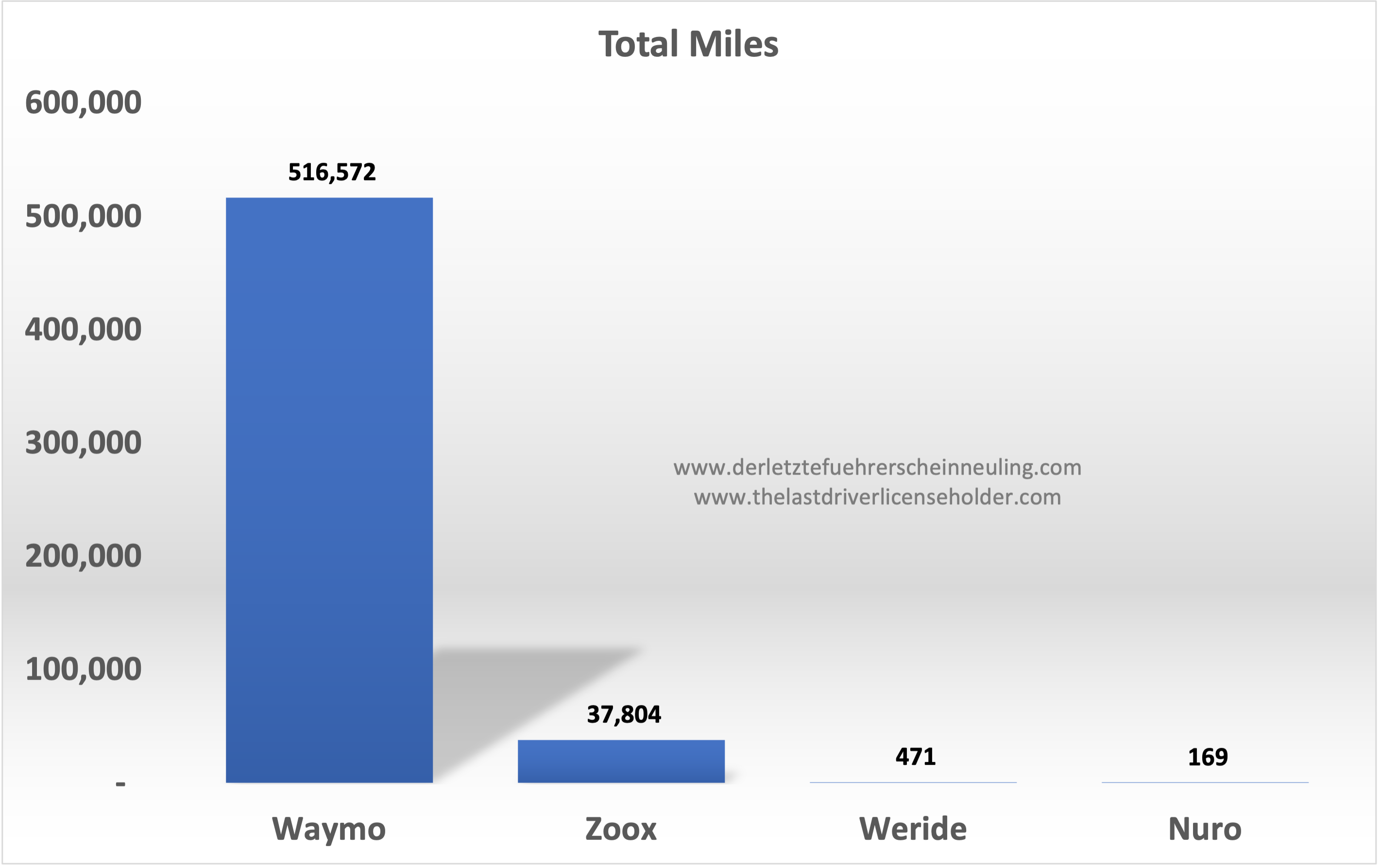
Note: I’m a bit confused about these numbers, because given the reported 150,000 driverless and paid rides Waymo has been completing weekly since October (50,000 per week as recently as May, 100,000 as of August), 826,515 driverless kilometers (516,572 miles) seems too low to me for the reporting period.
Conclusion
There have been several high-impact events this year. On the one hand, Cruise and Waymo were granted a license to commercially operate robotaxi fleets in August, but then Cruise’s accident thwarted these plans for the GM subsidiary. Nevertheless, we see that the activities have not decreased, but the driverless trips and the kilometers driven in this way have increased massively. As previously reported, Waymo has applied to expand its operations and Zoox has also opened a waiting list for interested parties. Apple’s intensified efforts also appear to be noteworthy.
The Last Driver’s License Holder Has Already Been Born
How the radical disruption of the auto industry affects you―and how you can prepare for the soon-to-be “new normal”
The combined effect of autonomous driving, electric vehicles, and the sharing economy is on the verge of changing the auto industry―all within the next decade. And this tech/economics revolution will touch virtually every industry.
It reveals the disruptive technologies now taking shape and provides a timeline of when they will take hold. It examines the impact on the industry itself, as well as adjacent sectors, including jobs and professions, city and street design, hospitals, insurances, politics, security, hospitality industry, the oil industry, real estate, and society at large.
Get the book on Amazon.
This article was also published in German.

 The Last Driver License Holder...
5 Comments