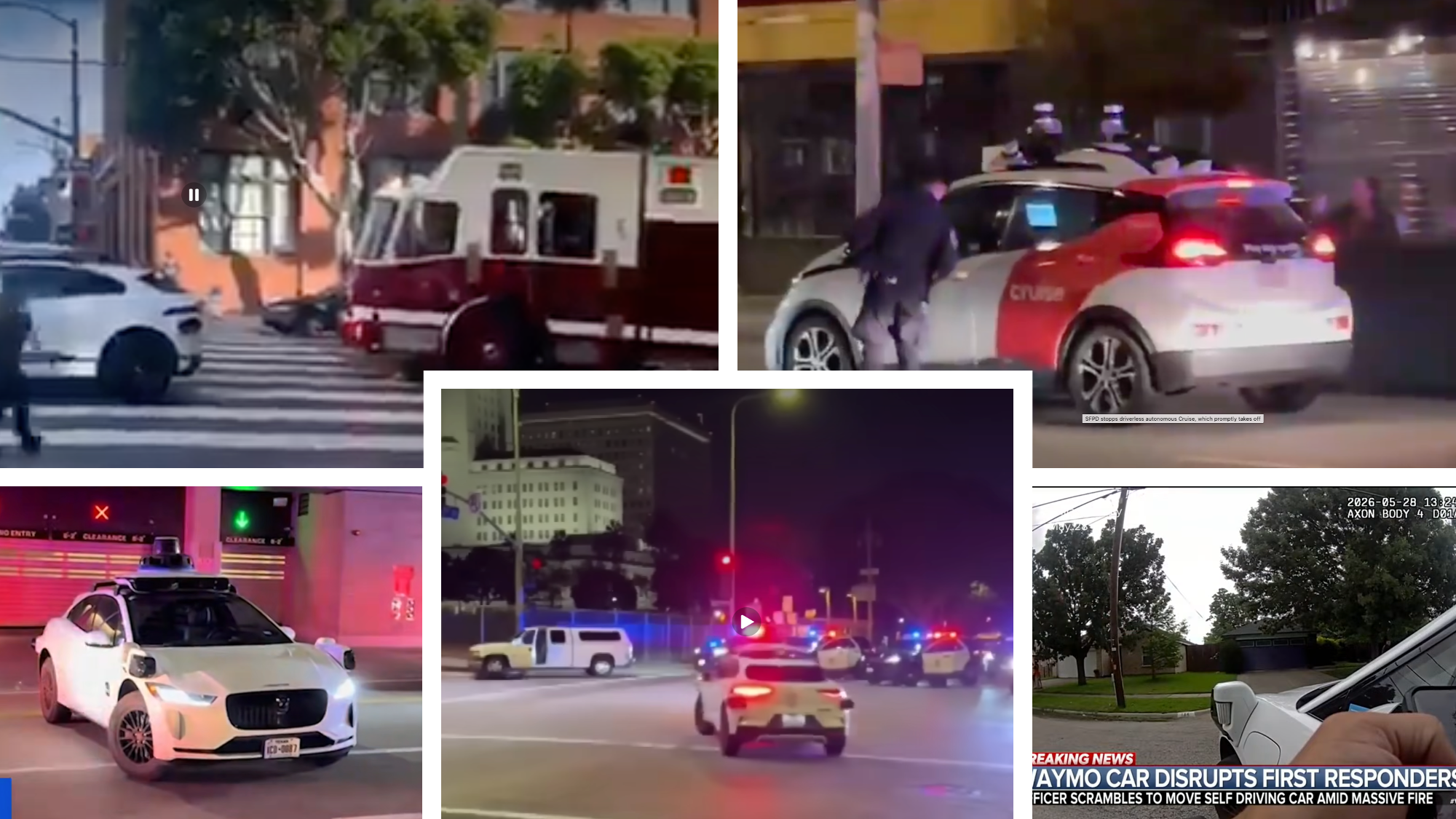
Several videos of Waymo vehicles are currently circulating that not only have difficulty following instructions from emergency responders but, in some cases, completely obstruct them. This has prompted both local and federal authorities to take action; they want to understand how often this happens and how Waymo, a Google subsidiary, plans to resolve the issue. Here are some of the incidents from the past few weeks and months.
The following video was filmed in Dallas, where a Waymo vehicle that had come to a stop across the road—and could only be moved manually by a firefighter after contacting the Waymo operations center—blocked emergency responders’ access to a house fire that resulted in fatalities.
Another incident involving a Waymo occurred during a mass shooting, where a Waymo appeared to be blocking emergency responders by parking across the road.
The Waymo vehicle ahead drove into an area in Hollywood that had been cordoned off due to a fire,
In this video from Los Angeles, a Waymo drives nonchalantly into a scene where several police vehicles have pulled over a car and the officers, with their weapons drawn, are urging the driver to get out.
And here’s a video from San Francisco, where a Waymo is stopped at an intersection and is blocking three emergency vehicles at once:
How are robotaxis and emergency responders trained?
Robotaxis are being trained to recognize emergency vehicles and interact with emergency responders. They must recognize that emergency vehicles are on a call, make way for them as required by U.S. regulations, and also determine whether they themselves are the ones being addressed. Here’s an example:
Waymo also spends some time training its robotaxis to recognize emergency vehicles and determine appropriate responses. This includes gestures made by emergency responders and members of the public, to which the robotaxis sometimes respond well, but at other times respond poorly or at the wrong moment. Waymo repeats these exercises in every new city where it launches its robotaxi service to also train local emergency responders on how robotaxis work and how to interact with them. Waymo provides its own training materials on its website, as does the Governors Highway Safety Association.
How serious is the problem?
From April 22, 2025, to May 1, 2026, the San Francisco Fire Department (SFFD) recorded and reported 31 incidents in which Waymo vehicles obstructed emergency responders.

William Riggs, a professor at the University of San Francisco, is deeply involved in the field of autonomous vehicles and advises both government agencies and the industry. In a LinkedIn post, he also raised the valid question—one I’ve already asked—of just how serious the problem really is. And to answer that, we need comparative data. If the San Francisco Fire Department (SFFD) has reported 31 incidents, we need to put that into context by considering the number of Waymos and the kilometers driven, and compare it to incidents involving human drivers. Riggs writes:
But that’s kind of the issue. San Francisco has created a dedicated reporting system for autonomous vehicle incidents; a super small segment of total travel on our roads; but has nothing comparable for human drivers. Every time an AV is perceived to block an apparatus, hesitate, or interfere with emergency operations, there’s a mechanism to document it; not so if you are human. [..]
It’s not being systematically measured and as researchers and policy analysts, we need to be systematic in our assessments. We should not only be asking “How many AV incidents occurred?” but understand “Compared to what?” Without a comparable human dataset it’s hard to draw any conclusions about relative performance or risk.
In other words: there are no records of incidents involving human drivers. Yet, given that there are nearly 500,000 registered vehicles in San Francisco compared to the 1,000 Waymos in operation throughout the San Francisco Bay Area, we can assume that there must be at least a few incidents involving human drivers. Not just one or two, but likely thousands or even tens of thousands during the same period.
Of course, manufacturers of autonomous cars need to improve their algorithms to enhance interaction with emergency responders. There’s no question about that. But without a point of comparison, it looks more as though this technological innovation is better suited for news stories and sensationalism than what we’ve come to accept as normal over the years. As we all know, “dog bites man” isn’t news, but “man bites dog”—now that’s a story worth telling.
People blocking emergency vehicles
A few videos from around the world clearly illustrate just how serious the problem of obstructing emergency vehicles and personnel is. Here is an example from Germany that shows the rather baffling behavior of a driver who simply refuses to clear the way for the fire department during an emergency response.
Here’s an example from Birmingham, where a vehicle parked in the second lane is blocking a fire truck on a call.
In June, I witnessed a scene in my hometown of Vienna when, at a very busy intersection near the Urania, an ambulance was trying to cross the intersection on a red light, and a pedestrian wearing headphones—completely oblivious to his surroundings—was crossing the street and walked right in front of the ambulance. Here’s a video from the intersection I just mentioned, where a teenager, without looking, almost runs into the path of the ambulance.
Cyclists, too, often pay little attention to emergency vehicles and even risk their lives in the process, as can be seen in this unbelievable example. Here, too, the cyclist is wearing headphones and doesn’t seem to hear the emergency vehicle.
Authorities are therefore required to collect data on such incidents involving all road users and to implement and mandate appropriate measures to improve the situation—but not selectively for a single group of road users.
Note: Jonathan Slotkin, an American neurosurgeon, has written an article in which he points out the paradox that we expect perfection from machines but accept carnage caused by humans.
This article was also published in German.


