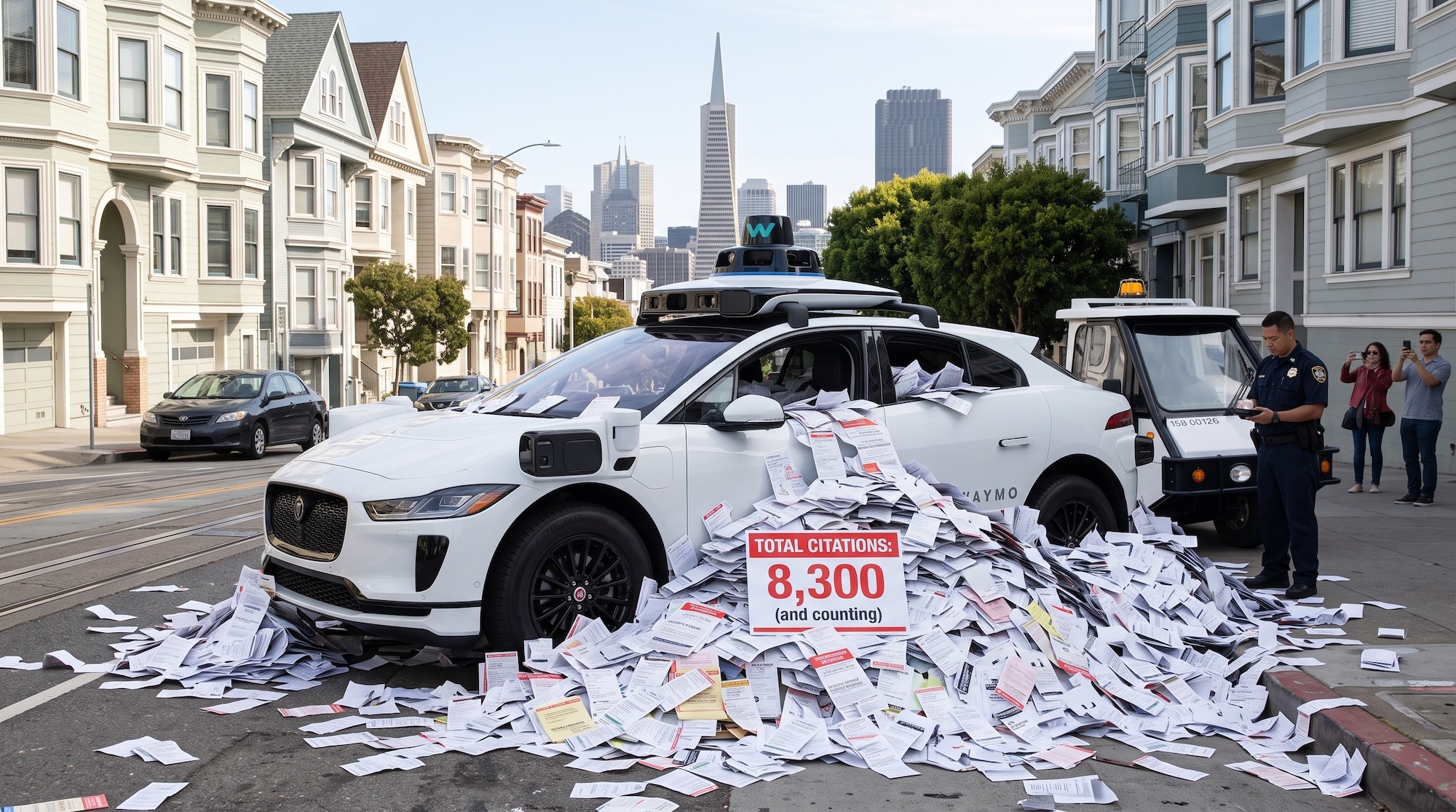
According to the City of San Francisco, Waymo received a total of 8,309 parking tickets between January 2025 and July 17, 2026, all for illegal parking. According to the Gazetter, there were exactly 4,178 in 2025, and 4,131 in the first half of the year alone. Waymo had to pay $957,008 (€825,898) in fines during those 18 months. This means Waymo received 106 parking tickets per week and paid $12,000 (€10,356). By comparison, in all of 2024, Waymo received 589 parking tickets for illegal parking, totaling $65,065 (€56,145) in fines.
This represents a dramatic increase in fines and is a sign of the expansion of Waymo’s robotaxi service. Waymo operates more than 1,200 robotaxis in the San Francisco Bay Area and nearly 4,000 across the United States.
Data from the San Francisco Municipal Transportation Agency (SFMTA) for the period from January 2025 to July 2026 shows that the most common violation committed by Waymo robotaxis in the city—accounting for 2,038 tickets—was “parking in transit zones,” meaning occupying a parking space designated for a specific type of vehicle, such as a tour bus. The next most common violations were parking in prohibited spaces, obstructing traffic, parking in the second lane, and blocking bike lanes.
The location where the most tickets were issued was 85 North Point Street—one block from Pier 39 at Fisherman’s Wharf—where Waymo vehicles were ticketed 577 times. Notably, the second-most frequent location (with 369 tickets) was just two blocks away at 150 Beach Street, in front of a parking garage. Waymos also received 288 tickets on Drumm Street, a 400-meter stretch in the Financial District next to Embarcadero Plaza.
However, the city’s response to robotaxis receiving parking tickets for illegal parking must be viewed through a different lens. “Illegal parking” isn’t necessarily the right term. The vehicles stop when they’ve been ordered and wait for passengers to get in or out. While San Francisco’s traffic regulations specify where and how far from the curb a taxi (and thus also a robotaxi) must stop—namely, no more than 12 inches (30 centimeters) and not at bus stops, in front of fire hydrants, in front of red-marked curbs, in front of driveways, on bike paths, and the like— given the nearly 500,000 vehicles registered in San Francisco and the extremely tight parking situation, it is nearly impossible to find such spots without picking up or dropping off passengers too far from their pickup and drop-off locations.

HOMO SYNTHETICUS
Wie Mensch und Maschine verschmelzen
Künstliche Intelligenz wird sichtbar. In „Homo Syntheticus“ beschreibt Zukunftsforscher Dr. Mario Herger den Aufbruch in ein neues Zeitalter, in dem Maschinen nicht mehr nur denken, sondern fühlen, handeln und lernen. Humanoide Roboter mit künstlicher Haut und autonomem Bewusstsein treten in unser Leben – als Helfer, Kollegen, vielleicht Partner. Gleichzeitig erweitern wir Menschen uns selbst: durch Implantate, Schnittstellen und KI im Körper. Mensch und Maschine nähern sich an, verschmelzen – und stellen unsere Vorstellung von Identität, Ethik und Fortschritt auf die Probe. Ein faszinierender Blick auf die Ära des synthetischen Menschen.
This situation raises a question that gets lost in the discussion: Who is public space actually intended for, and who is allowed to use it? Is it for parked private cars, restaurants with outdoor seating, children playing, neighbors sitting around, trees and greenery, parking micro-mobility vehicles like e-scooters and bicycles, or for cars? And which cars take priority? Buses, taxis, Uber, Lyft, and robotaxis, which serve sustainable mobility, or private cars that go unused 95% of the time?
I discussed this issue just recently in another post, and it’s also worth consulting the work of the (late) urban planner Donald Shoup, whose book—with its telling title, The High Cost of Free Parking—already offers a glimpse into how the City of San Francisco and the SFMTA should rethink their approach. With Waymo as the city’s first robotaxi fleet—and Zoox, Pony, Tesla, and others soon to follow—the problem will only get worse. From a first-principles perspective, it would seem clear that more parking spaces in public spaces should be freed up for shared systems and micromobility, but this is countered by the practical reality that private car owners are voters who want to be courted—otherwise, the political careers of city officials will quickly end in defeat at the polls. And voters who own cars will not want to give up their privileges without a fight.
In other words: when the city enacts laws and regulations that are unrealistic and nearly impossible to comply with (e.g., a maximum of 12 inches from the curb when getting in and out, no double parking, no PUDOs at 95% of curbs…), the city is effectively creating a guaranteed source of revenue for itself. As a result, we’re almost certain to continue seeing San Francisco harass robotaxi fleets and rake in a fortune, instead of rethinking and redesigning its entire spatial management system.
This article was also published in German.


Another consideration: when a human driver parks in a no parking zone, the traffic enforcer yells at the human to move it or they will get a ticket. When there is no human driver, there is no one to yell at.
LikeLike